
Hair Loss Treatment for Women
Hair Loss Treatment for Women: Causes, Diagnosis & Treatment Options
Written by:

Mindshape Content Team
Medically Reviewed by:

Most women who bring up hair loss with a clinician have already tried something on their own first. A different shampoo. A supplement a friend recommended. Cutting out gluten. That instinct makes sense. It’s also usually the wrong starting point. Hair loss in women has more possible causes than hair loss in men, and the right hair loss treatment for women depends on which cause you actually have.
This guide walks through that process in order: the main causes, how a real diagnostic workup tells them apart, and which treatments apply to each. Every claim is attributed to a named source at the end. Where the evidence is genuinely mixed, like the exact iron level worth treating, we say so instead of pretending there’s one clean number.
Hair loss in women is usually one of a few things. Pattern hair loss causes gradual thinning with the hairline intact. Telogen effluvium causes shedding a few months after a physical or hormonal shock. A hormonal or nutritional cause, such as thyroid disease, low iron, or PCOS, can drive either pattern. Less often, it’s alopecia areata, an autoimmune condition that causes round patches. Diagnosis rests on your history, a scalp exam, and a handful of blood tests. The right hair loss treatment for women follows from the cause. Topical minoxidil is the only medication FDA-approved for women, and correcting an underlying issue often helps as much as any medication does.
How Common Is Hair Loss in Women, and How Serious Is It?
MedlinePlus estimates about 30 million women in the United States are affected. Cleveland Clinic cites that same figure. Cleveland Clinic’s broader number is different: it puts the share of women who will notice some hair loss at some point above 50%. That’s measuring something wider than pattern loss alone. Mayo Clinic dermatologist Dawn Davis put a number on one end of that range. In a Mayo Clinic Minute segment, she noted that by age 70, about 55% of women have some hair loss.
None of that means hair loss is untreatable. It does mean two things. First, it’s genuinely common, so you’re not dealing with something rare or strange. Second, “hair loss” covers several different conditions, and a single number can’t tell you which one you have.
The Main Causes of Hair Loss in Women
There are several types of hair loss in women, and they don’t all come from the same place. Here they are, roughly in order of how often each one shows up.
Pattern hair loss
The most common cause is pattern hair loss, also called female pattern hair loss or female androgenetic alopecia. The part gradually widens, and density drops across the top of the scalp, while the hairline at the front is usually spared. We cover exactly how this compares to male pattern baldness in a [dedicated guide]; this section stays focused on the bigger picture of causes.
Telogen effluvium (shedding after a trigger)
Telogen effluvium is a temporary increase in shedding. It usually starts two to four months after a physical or emotional stressor: childbirth, a high fever or illness, surgery, rapid weight loss, or a new medication. It’s one of the most common reasons for a sudden change, as opposed to the slow drift of pattern loss. Most cases resolve on their own within six to nine months once the trigger passes. A smaller number of women develop a chronic version that drags on longer.
Alopecia areata
Alopecia areata in women is a different kind of problem entirely: an autoimmune condition where the immune system attacks hair follicles directly. It doesn’t look like pattern thinning. According to MedlinePlus, it typically starts as one or more smooth, round or oval patches, most often on the scalp. Short, tapered “exclamation point” hairs are sometimes visible at the edge of a patch. Nail pitting can also occur. Patches can appear and then resolve on their own. In a minority of cases, the condition progresses to total scalp hair loss, or rarely, loss of all body hair.
Hormonal causes
Several hormonal conditions can drive hair thinning:
PCOS: Polycystic ovary syndrome raises the risk of pattern-type hair loss. It often travels with other signs of the same hormonal picture: irregular cycles, acne, or extra hair growth on the face or body. We go deeper on this connection in our PCOS and hair loss guide.
Thyroid disease: Both an underactive and an overactive thyroid can cause diffuse shedding, which is part of why thyroid function is a standard early test.
Menopause: Hair loss becomes more likely after menopause, tied to the drop in estrogen. This deserves its own discussion, which we cover separately.
Pregnancy and postpartum: Many women notice thicker hair during pregnancy, followed by a shedding phase in the months after delivery as hormones reset. This is a form of telogen effluvium, and it usually settles on its own.
Nutritional causes
Low iron, specifically low ferritin, the protein that stores iron in the body, is one of the better-documented nutritional contributors. That’s why it’s a standard part of any workup; exactly what level matters is covered in the diagnosis section below.
Rapid weight loss, very restrictive dieting, and inadequate protein intake can also trigger shedding. Vitamin D deficiency has been studied as a contributing factor too, though its role is less settled than iron’s.
Medications and other treatments
Some medications list hair loss as a side effect, including certain blood pressure drugs, mood stabilizers, retinoids, and changes in hormonal birth control. If shedding started within a few months of a new prescription, that timing is worth mentioning to whoever manages the medication.
Scarring alopecias
These are less common, but more urgent. Conditions like frontal fibrosing alopecia cause permanent damage to the hair follicle, which is why they need a dermatologist’s attention promptly rather than a wait-and-see approach. Warning signs include a visibly receding hairline, scalp redness or scaling, burning or itching at the affected area, and eyebrow thinning alongside scalp changes.
How Is Hair Loss in Women Diagnosed?
This is the part most hair-loss content skips past. A real hair loss diagnosis is also the most useful part, because the right test can turn a guess into an actual plan.
The history and examination
A good visit starts with questions, not tests. When did the change start? Was it sudden or gradual? Did shedding increase, or did the hair just get thinner? Your clinician will also ask about your menstrual and pregnancy history, any recent illness or weight change, your family history, and every medication and supplement you take.
The clinician will examine your scalp directly: where the thinning is, whether the hairline has moved, and whether the scalp looks normal or shows redness or scaling. A gentle pull test, tugging a small tuft of hair to see how much comes away, helps flag active shedding.
Hair loss blood tests: what gets checked
Which labs make sense depends on your history, but a hair loss blood test panel most often includes:
- Ferritin, to check iron stores. This is the one number in this whole topic without a single agreed-upon cutoff. A standard lab usually flags ferritin as low only below about 12 to 15 ng/mL. A 2023 clinical guide in the dermatology journal Cutis takes a different view for hair loss specifically. It recommends a higher threshold, around 40 ng/mL, to rule out iron deficiency in someone who’s otherwise healthy. In anyone with an inflammatory condition that can distort the number, it recommends going higher still, to around 70 ng/mL. In plain terms, your ferritin can look “normal” on a standard lab report and still be low enough to matter for your hair. That’s worth asking about directly rather than assuming a normal-range result closes the question.
- Thyroid function (TSH, sometimes with free T4). Both low and high thyroid function can cause diffuse shedding.
- Vitamin D. Less consistently linked than iron, but commonly checked alongside it.
- A hormone or androgen panel, added when your history includes irregular periods, acne, or excess facial or body hair, to check for PCOS or another androgen-related cause.
- A complete blood count, mainly to catch anemia that a ferritin result alone might not fully explain.
Dermoscopy and biopsy
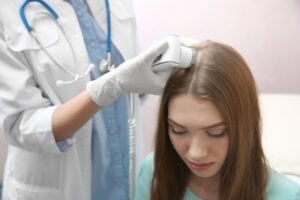
A clinician can also use dermoscopy: a handheld magnifier built for the scalp. It confirms pattern loss and rules out look-alikes without any cutting or sampling. A scalp biopsy is not routine. It’s reserved for cases where the diagnosis isn’t clear from the history, exam, and dermoscopy alone, or when a scarring process is suspected. Most women never need one.
When to see a dermatologist instead of, or in addition to, a general clinician
A clinician managing your general health can evaluate and treat a lot of this. That includes ordering the standard labs, starting topical minoxidil, and managing an underlying thyroid or PCOS issue. What that clinician generally can’t do by video is biopsy a scalp or treat a scarring condition. See a dermatologist in person for round patchy spots, a hairline that’s visibly moving, or scalp pain, burning, or scaling. The same goes for hair loss that’s progressing within days or weeks rather than months.
Hair Loss Treatment for Women: What Actually Works
Treatment follows from the cause. For medications specifically, it also follows from what’s actually approved for women, versus what isn’t.
Topical minoxidil — the only FDA-approved option
Topical minoxidil is the only medication FDA-approved specifically for hair loss in women, as a 2% solution used twice daily or a 5% foam used once daily. A 2025 clinical review by a group of hair-loss specialists, published in the Journal of the American Academy of Dermatology, lays out the timeline. Visible results take at least four months and are better judged at six to twelve months. Stopping treatment lets hair return to its prior baseline over about four months. Scalp irritation is the most common downside, usually traced to one ingredient in the solution rather than the foam, which is why switching formulations often fixes it.
Oral minoxidil — off-label, and increasingly common
A low daily dose of minoxidil taken as a pill has no FDA approval for hair loss at all. Its only approval is for severe high blood pressure, at doses well above what’s used here. That makes the hair-loss use off-label by definition, even though it’s become common. The same 2025 review found that in controlled trials, a low oral dose performed comparably to the topical solution. It requires screening for certain heart conditions first, and it isn’t used in pregnancy or while breastfeeding.
Why finasteride isn’t the answer for most women
Finasteride is FDA-approved for pattern hair loss in men only. Its prescribing label states plainly that it isn’t indicated for women. It’s also contraindicated in anyone who is or may become pregnant, because of a risk to a male fetus. The evidence in women is thin and mixed. One controlled trial found no benefit after menopause. The more encouraging results come from small, uncontrolled studies of premenopausal women on higher doses than men typically take. Where finasteride gets used in women at all, it’s a specialist decision, not a default option.
Anti-androgens (off-label)
Spironolactone, used off-label, sometimes gets added when a hormonal or androgen-related component is suspected. The evidence for this approach is limited, not absent. We cover this comparison directly, including how it differs from finasteride, in [a separate guide].
Treating the underlying cause
This step is easy to skip past in a rush toward medication, and it’s often the one that actually moves the needle. Correcting an iron deficiency, adjusting a thyroid problem, or managing PCOS can meaningfully improve shedding on its own. Sometimes that happens alongside a direct hair treatment, sometimes instead of one.
Procedures: microneedling, low-level laser, and PRP
These are typically used alongside minoxidil rather than in place of it. The same 2025 dermatology review notes that minoxidil’s effectiveness increases when it’s combined with microneedling, low-level laser treatment, or platelet-rich plasma (PRP) injections. None of these replace an actual diagnosis; they’re additions once pattern hair loss is confirmed, not a substitute for figuring out the cause first.
Hair transplantation
Transplantation is an option once hair loss has stabilized, generally in women over 25. It’s a poorer fit for many women than for men. Pattern hair loss in women is usually diffuse rather than confined to one area, which leaves less reliably “safe” donor hair to work with. It’s best left to a dermatologist or a hair-restoration specialist to evaluate, not something to pursue as a first move.
Hair care and options
Wash less aggressively, skip tight braids, ponytails, or caps that pull at the hairline, and go easy on harsh chemical treatments. None of that reverses an underlying cause, but it does reduce breakage on top of it.
How MindShape Evaluates and Treats Hair Loss in Women
At MindShape, a licensed clinician reviews your history, symptoms, and relevant labs in a video visit. From there, they build a plan around what’s actually driving your hair loss, rather than starting with a product. That might mean topical or oral minoxidil, treating an underlying thyroid or PCOS issue, or both.
Our clinicians are internal medicine physicians and advanced practice clinicians, not dermatologists, which fits well with the [hormonal] and nutritional causes covered above. If your case points toward something that needs an in-person dermatologist, such as patchy loss or a sign of scarring, we’ll tell you plainly and point you there. You can read more about how our [online hair loss treatment] works, or start with our [nutrition] team if low iron or diet looks like a factor.
Get a Personalized Hair Care Plan
The fastest route to the right treatment isn’t the newest product; it’s knowing which of these causes you’re actually dealing with. A clinician who checks your history, does a real exam, and orders the right labs can usually tell you that with real confidence.
If you’d like help working through what’s behind your hair loss, schedule a video visit with a MindShape clinician.
FAQs
Frequently Asked Questions
What is the most common cause of hair loss in women?
Pattern hair loss, also called female pattern hair loss, tops the list. The part widens and the crown thins while the frontal hairline usually holds its ground, and the odds of it happening increase with age, especially after menopause.
How do I know if my hair loss is temporary or permanent?
Shedding that started a few months after an illness, childbirth, surgery, or a major weight change is usually temporary telogen effluvium. It tends to resolve within six to nine months once the trigger passes. Gradual thinning with no clear trigger is more likely pattern hair loss, which is manageable but doesn’t reverse entirely on its own. A clinician can usually tell the difference from your history alone.
What blood tests are used to diagnose hair loss in women?
The most common blood test for hair loss in women checks ferritin, for iron stores, along with thyroid function. A vitamin D level or hormone panel gets added if your history suggests PCOS or another androgen-related cause. Ferritin is the one worth a second look if your result comes back “normal.” The standard lab cutoff is lower than what many hair-loss specialists consider adequate for hair specifically.
Is there a cure for hair loss in women?
It depends on the cause. Hair loss triggered by an iron deficiency, a thyroid problem, or childbirth often improves substantially once that cause is addressed. Pattern hair loss doesn’t have a cure, but it can usually be slowed, and often partly regrown, with consistent treatment. The benefit fades if treatment stops.
Can hair loss in women be a sign of something serious?
Usually not, but sometimes yes. Thyroid disease and PCOS are common, manageable causes. A receding hairline, scalp redness or scaling, or rapidly progressing patchy loss can signal a scarring condition or alopecia areata. Both are worth a dermatologist’s attention sooner rather than later.
Should I see a dermatologist or a regular doctor for hair loss?
A general or internal medicine clinician can evaluate the common causes, order the standard labs, and start topical or oral minoxidil. Round bald patches, a hairline on the move, a sore or scaly scalp, or loss that’s advancing within days rather than months call for an in-person dermatologist. Those situations sometimes need a hands-on exam or a biopsy.
Does stress cause hair loss in women?
Significant stress can trigger telogen effluvium, the shedding phase described above, typically showing up a couple of months after the stressful period. It doesn’t cause pattern hair loss on its own, but it can make existing pattern loss more noticeable.
This article is for informational and educational purposes only and is not a substitute for professional medical advice, diagnosis, or treatment. If you are experiencing a medical emergency or a mental health crisis, please seek immediate care from emergency services or a local crisis line. This content has been written and reviewed by the Medical Team at mindshape.care. Read our full Medical Disclaimer.
References
View Clinical Sources & References
MindShape is dedicated to providing you with accurate and trustworthy health information.
- National Library of Medicine, MedlinePlus. Androgenetic Alopecia. Accessed on September 30, 2026 at https://medlineplus.gov/genetics/condition/androgenetic-alopecia/.
- National Library of Medicine, MedlinePlus. Alopecia Areata. Accessed on September 30, 2026 at https://medlineplus.gov/ency/article/001450.htm.
- Herskovitz I, Tosti A. Female Pattern Hair Loss. Accessed on September 30, 2026 at https://brieflands.com/journals/ijem/articles/17638.
- Zhang D, LaSenna C, Shields BE. Serum Ferritin Levels: A Clinical Guide in Patients With Hair Loss. Accessed on September 30, 2026 at https://pubmed.ncbi.nlm.nih.gov/37820340/.
- Olsen EA, Sinclair R, Hordinsky M, et al. Summation and Recommendations for the Safe and Effective Use of Topical and Oral Minoxidil. Accessed on September 30, 2026 at https://escholarship.org/uc/item/5d42s0q7.
- Cleveland Clinic. Hair Loss in Women. Accessed on September 30, 2026 at https://my.clevelandclinic.org/health/diseases/16921-hair-loss-in-women.
- Mayo Clinic News Network. Expert Advice for Women With Thinning Hair. Accessed on September 30, 2026 at https://newsnetwork.mayoclinic.org/discussion/mayo-clinic-minute-expert-advice-for-women-with-thinning-hair.
- Organon. PROPECIA (Finasteride) Prescribing Information. Accessed on September 30, 2026 at https://www.organon.com/product/usa/pi_circulars/p/propecia/propecia_pi.pdf.
Why You Can Rely on Us?
At Mindshape Clinic, we are committed to providing clear and trustworthy health information that you can rely on.
Reliable Information – Every article is based on credible sources.
Expert Review – Content is carefully checked before publishing.
Up to Date – We keep information current with the latest insights.
Clarity First – Our goal is to make knowledge simple and accessible.