Chronic Kidney Disease Stages
Chronic Kidney Disease Stages: What eGFR and uACR Actually Mean
Written by:

Mindshape Content Team
Medically Reviewed by:

Chronic kidney disease stages are built from two numbers, not one — and almost nobody explains that at the moment you need it most. If a lab portal just flagged your eGFR as low or your urine albumin as high, the instinct is to search for the worst-case version of what it means. Take a breath first. A single result rarely tells the whole story, and the two tests that define staging answer completely different questions about your kidneys.
This guide walks through both numbers in plain language: what eGFR measures, what uACR measures, how they combine into a stage, what each stage typically means for your care, and when a kidney specialist should get involved. It is written to help you have a sharper conversation with a clinician — not to diagnose yourself from a chart.
Chronic kidney disease is classified using three things: the cause, an eGFR category from G1 to G5, and a urine albumin category from A1 to A3. eGFR estimates filtration; uACR detects albumin leaking through damaged filters. The abnormality must persist at least three months to be considered chronic.
What chronic kidney disease actually means
Chronic kidney disease (CKD) is defined as an abnormality of kidney structure or function that has implications for health and has been present for at least three months. That abnormality can take several forms:
- Reduced filtration — an eGFR under 60 mL/min/1.73 m²
- Persistent albuminuria — a uACR of 30 mg/g or higher
- Abnormal urine sediment, such as persistent microscopic blood or cellular casts
- Structural changes visible on imaging, such as polycystic kidneys or scarring
- Electrolyte or tubular disorders caused by kidney dysfunction
- A history of kidney transplant
Why the three-month rule matters so much
A temporary drop in kidney function during dehydration, infection, surgery, or a medication reaction may be acute kidney injury — a different condition with a different trajectory. Acute kidney injury can improve. Chronic kidney disease, by definition, has already persisted.
Telling them apart usually requires prior lab records, at least one repeat test, and the wider clinical picture. This is exactly why a first abnormal result is a reason to investigate, not a reason to conclude.
CKD is usually silent early on
You can feel entirely well while your labs show a real change. That is the central problem with kidney disease — by the time symptoms appear, a substantial amount of function is often already gone. According to the CDC, roughly 1 in 7 US adults has CKD, and the large majority do not know it.
Screening matters most if you have:
- Type 1 or type 2 diabetes
- High blood pressure
- Cardiovascular disease or heart failure
- Obesity
- A family history of kidney disease
- A previous episode of acute kidney injury
- Long-term or frequent NSAID use
- Tobacco use
- Age 60 or older
What does eGFR measure?
The estimated glomerular filtration rate (eGFR) estimates how much blood your kidneys filter each minute, standardised to a body surface area of 1.73 m². The unit is written as mL/min/1.73 m².
Think of the glomeruli — the microscopic filtering units inside each kidney — as an extremely fine coffee filter. eGFR estimates how much liquid that filter can clean per minute. A healthy young adult typically filters somewhere around 100–120 mL/min.
Laboratories calculate eGFR from blood creatinine, a waste product generated by normal muscle metabolism. Healthy kidneys clear creatinine continuously, so higher blood creatinine usually corresponds to lower eGFR. That relationship is reliable across populations but imperfect in any single individual.
eGFR is an estimate, not a percentage of kidney function
This is the single most common misreading. An eGFR of 45 does not mean “45% of your kidneys are working.” It is a modelled estimate of filtration rate, and it is most useful when read alongside your previous results, your uACR, your medications and your overall clinical picture.
The 2021 CKD-EPI race-free equation
US laboratories have moved to the 2021 CKD-EPI creatinine equation, which removed race as a variable. In selected situations — significant muscle wasting, amputation, very high or very low muscle mass, a high-meat or vegetarian diet, or when a borderline result would change a treatment decision — a clinician may order cystatin C and use a combined creatinine–cystatin C equation for greater precision. This is not required for most patients.
eGFR categories (G1 to G5)
Note: categories G1 and G2 correspond to CKD Stage 1 and Stage 2 only when a separate, persistent marker of kidney damage is present.
| CKD Stage | eGFR | Description | What It Means |
|---|---|---|---|
| G1 | 90 or higher | Normal or high | Stage 1 CKD only if kidney damage is present for at least 3 months. |
| G2 | 60–89 | Mildly decreased | Stage 2 CKD only if another marker of kidney damage is present. |
| G3a | 45–59 | Mildly to moderately decreased | Stage 3a CKD if this level persists for at least 3 months. |
| G3b | 30–44 | Moderately to severely decreased | Stage 3b CKD with higher risk of disease progression. |
| G4 | 15–29 | Severely decreased | Stage 4 CKD. Specialist kidney care is generally recommended. |
| G5 | Below 15 | Kidney failure | Stage 5 CKD. Specialist management is required. |
Why stage 3 is split into 3a and 3b
“Stage 3 kidney disease” covers eGFR 30 to 59 — a wide functional range where the top and bottom behave differently. Splitting it lets clinicians:
- Stratify progression and cardiovascular risk more accurately
- Adjust drug dosing safely, since many medications have thresholds at eGFR below 45 or below 30
- Set monitoring frequency and decide on referral timing
Stage 3 does not mean dialysis is on the horizon. A stable G3a result with normal albumin is a very different clinical situation from G3b with heavy albuminuria and a falling trend.
Can you have CKD with an eGFR of 60 or higher?
Yes — but not on eGFR alone. Early CKD can exist with an eGFR of 70, 85, or even 100 if a marker of kidney damage persists for at least three months. Examples include elevated uACR, persistent microscopic hematuria, polycystic kidney disease or structural changes on ultrasound, or a prior kidney transplant.
The reverse is equally true: an eGFR of 75 with no albuminuria, no urine abnormalities, and no structural findings is not CKD. For many adults, particularly with age, that is simply normal kidney function.
What does uACR measure?
The urine albumin-to-creatinine ratio (uACR) measures albumin in urine relative to creatinine. Albumin is a protein that healthy kidney filters keep in the bloodstream. When the filtering barrier is damaged, albumin escapes into urine — a finding called albuminuria.
Reporting it as a ratio corrects for how dilute or concentrated a spot urine sample happens to be. In the United States it is reported in milligrams of albumin per gram of creatinine (mg/g).
That does not mean taping the mouth is safe or beneficial for everyone.
uACR albuminuria categories (A1 to A3)
| uACR Category | uACR (mg/g) | KDIGO Description | Plain-Language Meaning |
|---|---|---|---|
| A1 | Below 30 | Normal to mildly increased | Low albumin leakage. Reassuring, but it does not rule out every kidney problem. |
| A2 | 30–300 | Moderately increased | More albumin than expected. Confirmation on a repeat sample and a cause assessment are usually needed. |
| A3 | Above 300 | Severely increased | Substantial leakage, with clearly elevated kidney and cardiovascular risk. |
Why uACR matters even when eGFR looks fine
uACR can detect filter damage years before eGFR begins to fall. That is why a normal creatinine result alone is not enough to rule out kidney disease in someone with diabetes, high blood pressure, heart failure, or cardiovascular disease. If your last kidney check was a blood test only, ask whether you had a urine albumin test. In practice, it frequently is not — and it is the test more likely to catch trouble early. Our guide to a [high uACR] goes deeper on what to do with an abnormal result.
Can uACR be temporarily high?
Yes. A uACR can rise transiently after intense exercise within 24 hours, during fever or active infection, with a urinary tract infection, during menstrual or urinary bleeding, in a heart failure flare, or after a sharp spike in blood pressure or blood sugar.
Clinicians typically repeat the test — often on a first-morning urine sample — to establish whether the finding persists. Do not dismiss a high result, and do not assume a single sample proves permanent damage.
How eGFR and uACR work together: the KDIGO risk grid
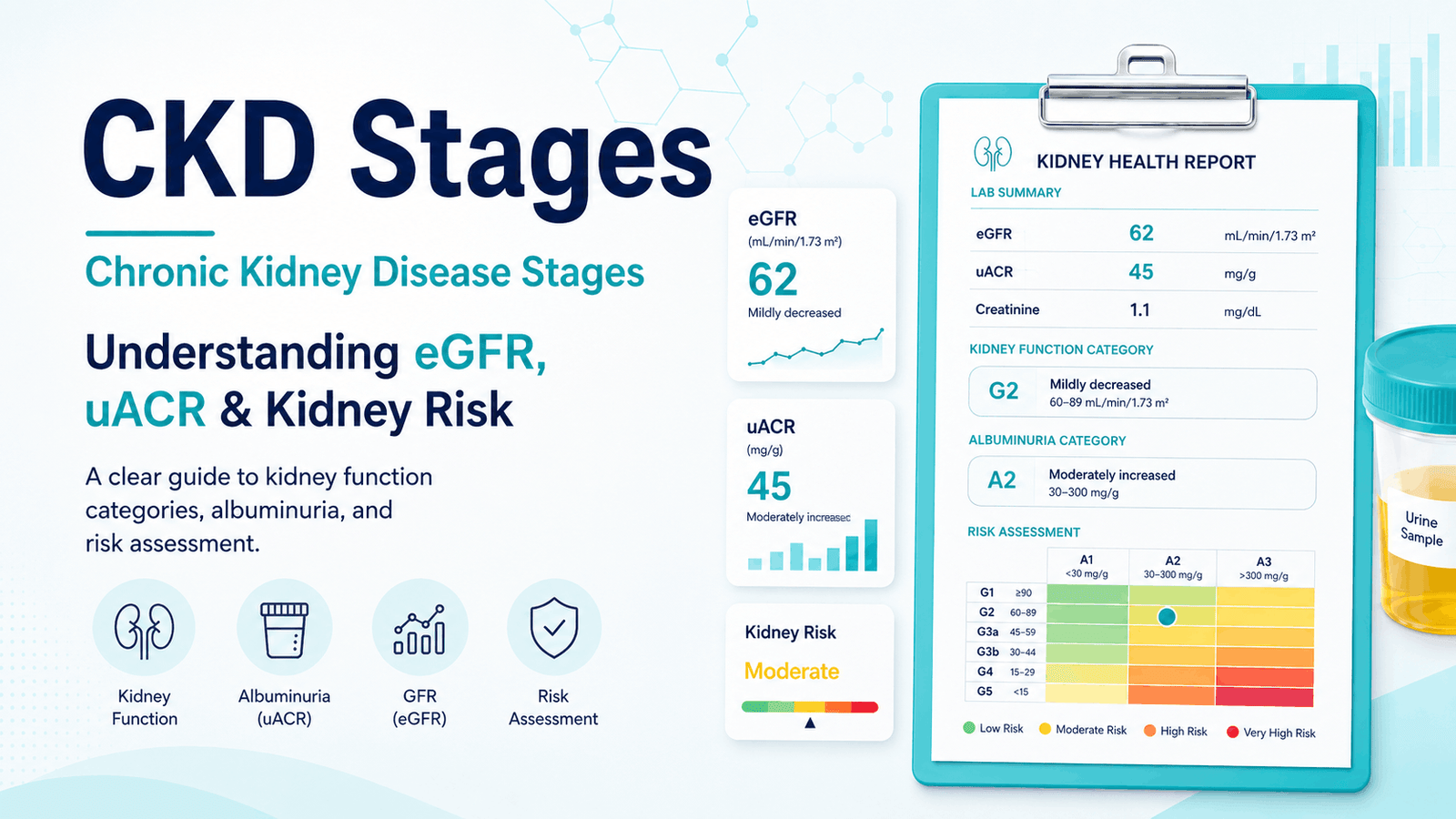
KDIGO combines cause (C), eGFR category (G), and albuminuria category (A) into what clinicians call the CGA classification. Risk increases as eGFR falls and as uACR rises — and the two multiply rather than add. The following table shows how CKD risk changes based on the combination of eGFR and uACR levels.
| eGFR Category | A1 — Below 30 mg/g | A2 — 30–300 mg/g | A3 — Above 300 mg/g |
|---|---|---|---|
| G1 — 90 or higher | Low risk (not CKD without another marker) | Moderately increased risk | High risk |
| G2 — 60–89 | Low risk (not CKD without another marker) | Moderately increased risk | High risk |
| G3a — 45–59 | Moderately increased risk | High risk | Very high risk |
| G3b — 30–44 | High risk | Very high risk | Very high risk |
| G4 — 15–29 | Very high risk | Very high risk | Very high risk |
| G5 — Below 15 | Very high risk | Very high risk | Very high risk |
Four worked examples
eGFR 74 with uACR 12 mg/g (G2, A1). Near-normal filtration, no albumin leakage. Without imaging abnormalities or hematuria, this does not meet criteria for CKD.
eGFR 74 with uACR 160 mg/g, confirmed on repeat (G2, A2). Filtration is preserved, but persistent filter damage is present. This meets criteria for CKD Stage 2 and warrants kidney-protective treatment even though the eGFR “looks fine.”
eGFR 52 with uACR 8 mg/g for more than three months (G3a, A1). Meets criteria for Stage 3a. Filtration is reduced, but with low albuminuria the overall risk profile is considerably better than the next example.
eGFR 52 with uACR 520 mg/g (G3a, A3). Same eGFR, very different situation. Severe albuminuria substantially raises progression and cardiovascular risk, and this combination usually calls for prompt cause assessment, treatment escalation and specialist input.
These are educational illustrations, not diagnoses. A useful question at your next visit: “What are my G and A categories, and how have both changed over time?”
Why one abnormal kidney result often needs repeating
Patient portals flag values outside a reference range. They do not diagnose CKD. A clinician’s first question is whether the finding is chronic and whether anything temporary could explain it.
Evidence-based OSA treatments are designed to keep the airway open, reduce airway obstruction, or address factors contributing to the condition. Mouth tape does not reliably perform these functions.
Things that can shift creatinine and eGFR
- Dehydration or a recent acute illness — reduced kidney perfusion lowers eGFR temporarily
- Intense exercise before the blood draw — muscle turnover raises creatinine
- A large cooked-meat meal, or creatine supplements — raises creatinine without changing true filtration
- Starting a kidney-protective medication (ACE inhibitor, ARB, or SGLT2 inhibitor) — often causes an initial, expected dip in eGFR that reflects reduced pressure inside the glomerulus, not damage
- Medications that block tubular creatinine secretion, such as trimethoprim or cimetidine — raise measured creatinine without lowering true GFR
- Unusually high or low muscle mass
- Rapidly changing kidney function, where steady-state equations are simply less reliable
Things that can temporarily raise uACR
- Intense physical activity within 24 hours
- Fever, active infection, or a urinary tract infection
- Menstrual or urinary tract bleeding
- Sharp transient spikes in blood pressure or blood glucose
Do not try to “improve” a test by over-hydrating, skipping a prescription, or overhauling your diet the week before a draw. Tell your clinician what was happening around the test instead, and follow the lab’s preparation instructions.
What happens at each of the chronic kidney disease stages
A stage describes part of the picture. It does not prescribe a single universal treatment plan.
G1 and G2 — confirm whether damage is really present
The priority is confirming the marker of damage and identifying the likely cause. Expect a review of uACR, urinalysis, blood pressure, glucose or A1c, medications, family history, and any prior imaging.
If CKD is confirmed, this is the highest-leverage moment in the entire disease course. Blood pressure control, glucose control, cardiovascular risk reduction, stopping tobacco and reviewing medication safety all matter more here than they ever will again.
G3a and G3b — monitor function, risk and complications
Persistent eGFR between 30 and 59 is Stage 3 CKD. Care usually includes confirming the cause, tracking the trend, monitoring uACR, checking medication doses and interactions, managing blood pressure and diabetes, and screening for complications such as anemia and mineral-bone changes as eGFR falls.
Some people need nephrology input in Stage 3 — particularly if the cause is unclear, uACR is significantly elevated, there is blood in the urine, or function is falling faster than expected. Many others are managed well by an internal medicine or primary care physician with referral when the picture changes.
G4 — bring in specialist kidney care and plan ahead
An eGFR of 15 to 29 is severely decreased filtration, and nephrology involvement is generally important. The care team typically evaluates anemia, potassium and acid-base balance, bone and mineral health, fluid status, nutrition and medication safety.
Planning ahead is not the same as starting treatment. It means there is time — unhurried time — to discuss transplant evaluation, dialysis options and comprehensive conservative care while continuing to treat the underlying disease.
G5 — individualized specialist management of kidney failure
An eGFR below 15, when chronic, is kidney failure. Dialysis is not started because a number crossed a line; timing depends on symptoms, fluid status, electrolyte and acid-base problems, nutrition, quality of life, the trend, and shared decision-making. Transplant evaluation is often discussed before dialysis is needed. Some people choose comprehensive conservative management instead of dialysis, which requires detailed specialist counselling.
How treatment connects back to eGFR and uACR
The point of staging is safer, more individualised care — not a label. Modern CKD management focuses on protecting remaining function and lowering cardiovascular risk, which is the leading cause of death in CKD.
Guideline-directed medications
- ACE inhibitors or ARBs. First-line for people with CKD, hypertension and albuminuria. They lower pressure inside the glomerulus and reduce albumin leakage. An expected small rise in creatinine after starting is monitored, not automatically a reason to stop.
- SGLT2 inhibitors. Now foundational kidney-protective therapy. KDIGO 2024 recommends them for adults with CKD and type 2 diabetes, and for many adults with CKD without diabetes — the eligibility thresholds depend on eGFR and uACR, which is exactly why both numbers matter.
- Non-steroidal mineralocorticoid receptor antagonists. Finerenone is an option for selected people with type 2 diabetes, CKD with albuminuria, adequate eGFR and normal potassium, on top of a maximally tolerated ACE inhibitor or ARB.
- Statins. Recommended for most adults aged 50 and over with CKD not on dialysis, for cardiovascular protection.
Blood pressure, glucose and lifestyle
- Individualised blood pressure targets, measured with proper standardised technique — home readings are genuinely useful here
- Individualised A1c targets if you have diabetes
- Sodium generally below about 2,000 mg per day
- Protein intake moderated rather than eliminated; a renal dietitian is the right person to set the number
- Avoiding regular NSAID use (ibuprofen, naproxen) and reviewing all supplements and herbal products with a clinician
- Tobacco cessation, regular activity, weight management, and treating sleep apnea if present
Do not start, stop, or change any prescription medication based on information from an article. Kidney-protective medications can help slow CKD progression, but they may also affect creatinine, potassium levels, blood pressure, and fluid balance, which is why regular monitoring by a healthcare professional is important. Learn more about treatments, lifestyle changes, and factors that may influence disease progression in our guide: Can Chronic Kidney Disease Be Reversed?
When should you see a nephrologist?
A nephrologist is a physician who specialises in kidney disease. Common reasons for referral include:
- eGFR below 30 mL/min/1.73 m² (G4 or G5)
- A rapid or unexplained decline in eGFR
- Severe persistent albuminuria (uACR above 300 mg/g)
- Persistent unexplained blood in the urine, or red blood cell casts
- An unclear or unusual cause of CKD
- Resistant hypertension, persistent hyperkalemia, anemia, or acid-base problems that are hard to manage
- Recurrent kidney stones or known hereditary kidney disease
- A kidney failure risk estimate high enough to change planning
- The need to discuss biopsy, dialysis, transplant evaluation, or conservative care
Referral is never based on one cutoff alone. Someone with a higher eGFR can need nephrology sooner because of heavy albuminuria, a fast decline, or an unclear diagnosis.
Can eGFR and uACR results be reviewed through virtual care?
Much of CKD evaluation and follow-up can begin virtually when it is clinically appropriate and the clinician is licensed in your state.
What an online internal medicine physician can do
- Review your eGFR, creatinine, uACR, urinalysis, potassium, glucose, and A1c results — and, more importantly, the trend across them.
- Perform a full medication review, including over-the-counter pain relievers, vitamins, and supplements.
- Discuss home blood pressure and glucose readings.
- Evaluate risk factors and connected conditions: hypertension, type 2 diabetes, obesity, cardiovascular risk, sleep apnea.
- Order or recommend follow-up blood and urine testing where clinically and legally appropriate.
- Initiate or adjust eligible medications with appropriate monitoring.
- Coordinate local imaging, in-person evaluation, renal dietitian support, or nephrology referral.
What still requires in-person care
Blood draws and urine collection happen at a lab. Ultrasound and other imaging are done locally. Physical examination, kidney biopsy, dialysis access procedures, dialysis itself, transplant evaluation and any emergency assessment require in-person care.
At MindShape, Hassan Khan, DO, is a board-certified internal medicine physician providing care online. He is an internist, not a nephrologist — virtual internal medicine care can support lab interpretation and management of CKD and its connected conditions, with nephrology or local care added when the situation calls for it.
Learn more about virtual chronic kidney disease treatment, online hypertension treatment, and diabetes management online.
A scheduled video visit works well for stable lab review, medication assessment, chronic condition follow-up and care coordination. It is not the right setting for severe symptoms, a rapidly changing condition, or an emergency.
What to bring to a kidney results appointment
- Complete lab reports with dates, units, and reference ranges — not just screenshots of flagged values
- Prior creatinine, eGFR, uACR, urinalysis, potassium, glucose or A1c, and blood pressure results
- A current list of prescriptions, over-the-counter medicines, vitamins, herbs and supplements with doses
- Home blood pressure and glucose readings if you track them
- A short timeline of illnesses, dehydration, infections, medication changes, or intense exercise near the test date
- Relevant imaging, hospital records, and any history of acute kidney injury
- Family history of kidney disease, dialysis, transplant, or inherited kidney conditions
- Any new symptoms: swelling, changes in urination, shortness of breath, nausea, weakness, or confusion
When kidney symptoms need urgent or emergency care
Do not wait for a routine appointment if you may be seriously unwell.
Call 911 or go to an emergency department for chest pain, severe difficulty breathing, fainting, seizure, severe confusion, or another life-threatening symptom.
Seek prompt local medical evaluation for very little or no urine output, rapidly worsening swelling, persistent vomiting, visible blood in the urine, severe weakness, a sudden major change in mental status, or a critical potassium or kidney result that a lab or clinician has told you needs immediate attention.
If you are unsure how urgent something is, contact a local healthcare professional or urgent care service. Online education cannot assess an emergency.
Understand your kidney numbers — and the next step
An eGFR or uACR result should lead to a clear conversation, not panic or guesswork. The real questions are whether the change is persistent, what is causing it, how the two numbers combine to shape your risk, and what monitoring or treatment fits your situation.
If you want help reviewing your kidney labs, medications, blood pressure and next steps, schedule a virtual visit with a MindShape internal medicine physician. Your provider will determine what is appropriate online and when nephrology, local testing or in-person care should be added.
Book a Virtual CKD Visit. Supporting line: Review your eGFR, uACR, medications, and next steps with an online internal medicine physician.
Care is available only where a MindShape clinician is licensed and when telehealth is clinically appropriate. Virtual visits are not for emergencies.
FAQs
Frequently Asked Questions
How many stages of chronic kidney disease are there?
There are five stages of CKD, numbered 1 through 5. The eGFR system uses six categories because Stage 3 is divided into G3a and G3b. Risk is then refined further using uACR categories A1, A2 and A3.
What eGFR level means chronic kidney disease?
An eGFR below 60 mL/min/1.73 m² that persists for at least three months meets the kidney-function criterion for CKD. An eGFR of 60 or higher can still be CKD when another marker of kidney damage — most often persistent albuminuria — is present.
Can you have kidney disease with a normal eGFR?
Yes. Stage 1 CKD is defined as an eGFR of 90 or higher together with a persistent marker of kidney damage, such as elevated uACR, structural changes on imaging, or persistent microscopic hematuria.
What uACR level is abnormal?
KDIGO classifies uACR below 30 mg/g as A1, 30 to 300 mg/g as A2, and above 300 mg/g as A3. A result of 30 mg/g or higher may indicate albuminuria, but clinicians usually repeat the test and rule out temporary causes before confirming CKD.
Is a low eGFR always permanent?
No. Dehydration, acute illness, medication effects and heavy exercise can all lower eGFR temporarily. CKD requires a persistent abnormality, usually across at least three months. A low result still deserves timely review.
What does stage 3 kidney disease mean?
Stage 3 means eGFR is persistently between 30 and 59 mL/min/1.73 m². G3a is 45 to 59 and G3b is 30 to 44. Your uACR, the underlying cause and the rate of change matter as much as the number itself.
Can chronic kidney disease be reversed?
Established scarring is generally not reversible, though some acute or treatable causes of abnormal results can improve. Treating the underlying cause and using guideline-directed medications can slow progression, lower albuminuria and reduce complications — sometimes substantially.
How often should eGFR and uACR be checked?
People with confirmed CKD are generally assessed at least annually, and more often when risk is higher, results are changing, or treatment is being started or adjusted. Your monitoring schedule should be set using both your G and A categories.
Does stage 5 mean dialysis starts immediately?
No. G5 is the kidney-failure range, but dialysis timing depends on symptoms, fluid status, electrolyte problems, nutrition, quality of life, trends and shared decision-making. Nephrology involvement is essential at this stage.
Can CKD be managed entirely online?
Stable follow-up, lab review, medication assessment and management of connected conditions can often be handled virtually. Blood and urine collection, imaging, biopsy, dialysis, transplant evaluation and emergency care require in-person services.
This article is for informational and educational purposes only and is not a substitute for professional medical advice, diagnosis, or treatment. If you are experiencing a medical emergency or a mental health crisis, please seek immediate care from emergency services or a local crisis line. This content has been written and reviewed by the Medical Team at mindshape.care. Read our full Medical Disclaimer.
References
View Clinical Sources & References
The following authoritative clinical sources support the medical information in this article.
- Kidney Disease: Improving Global Outcomes (KDIGO) CKD Work Group. KDIGO 2024 Clinical Practice Guideline for the Evaluation and Management of Chronic Kidney Disease . Kidney International. 2024;105(4S):S117–S314. Accessed August 24, 2026.
- National Kidney Foundation. KDOQI US Commentary on the KDIGO 2024 Clinical Practice Guideline for CKD . American Journal of Kidney Diseases. Accessed August 24, 2026.
- National Institute of Diabetes and Digestive and Kidney Diseases. Chronic Kidney Disease Tests & Diagnosis . Accessed August 24, 2026.
- National Kidney Foundation. Urine Albumin-to-Creatinine Ratio (uACR) . Accessed August 24, 2026.
- National Kidney Foundation. Estimated Glomerular Filtration Rate (eGFR) . Accessed August 24, 2026.
- Centers for Disease Control and Prevention. Chronic Kidney Disease Basics . Accessed August 24, 2026.
- Inker LA, Eneanya ND, Coresh J, et al. New Creatinine- and Cystatin C–Based Equations to Estimate GFR without Race . New England Journal of Medicine. 2021;385:1737–1749. Accessed August 24, 2026.
- American Kidney Fund. Stages of Kidney Disease . Accessed August 24, 2026.
Recent Blogs
Explore More Chronic Kidney Disease





Why You Can Rely on Us?
At Mindshape Clinic, we are committed to providing clear and trustworthy health information that you can rely on.
Reliable Information – Every article is based on credible sources.
Expert Review – Content is carefully checked before publishing.
Up to Date – We keep information current with the latest insights.
Clarity First – Our goal is to make knowledge simple and accessible.