FIT-DNA Test Vs Colonoscopy
Read Time: 3min
Written By

Dr. Hassan Khan
Internist
FIT-DNA Test vs Colonoscopy for Colorectal Cancer Screening
If you’re due for screening, you may be comparing FIT, the DNA test, vs. colonoscopy. Fortunately, you have options. A colonoscopy is the most complete test because it can find and remove polyps in one visit. Meanwhile, a FIT-DNA test is an at-home stool test that looks for hidden blood and certain DNA markers. However, if FIT-DNA is positive, you still need a colonoscopy to confirm the cause. So, the best choice is the one that matches your risk and that you will finish.
Table of Contents
FAQs
FAQs: FIT-DNA Test vs Colonoscopy
Please feel free to Send a Message or call us if your related question is not included here. we are happy to serve you.
No, not for all findings. While the FIT-DNA test is highly accurate at detecting existing colon cancer (~92-94%), it only finds about 43% of advanced precancerous polyps. In contrast, a colonoscopy detects over 95% of polyps and allows for their immediate removal, making it the superior tool for cancer prevention.
If your test is positive, you must schedule a diagnostic colonoscopy. A positive result indicates that DNA mutations or blood were found, which could signal cancer or polyps. In 2026, most insurance plans (including Medicare) cover this follow-up colonoscopy as a preventive service, but you should always verify with your provider.
If results are normal, a FIT-DNA test should be repeated every 3 years. A colonoscopy is typically required only once every 10 years for individuals at average risk. If you have a family history of colon cancer, your doctor will likely recommend only colonoscopies at more frequent intervals.
For average-risk individuals, it is an FDA-approved alternative, but it is not a replacement. The FIT-DNA test is a "detection" tool (finding cancer that is already there), while a colonoscopy is a "prevention" tool (stopping cancer before it starts by removing polyps).
One of the main benefits of the FIT-DNA test is that it requires no bowel prep, no fasting, and no dietary restrictions. You can eat normally and collect your sample at home at your convenience.
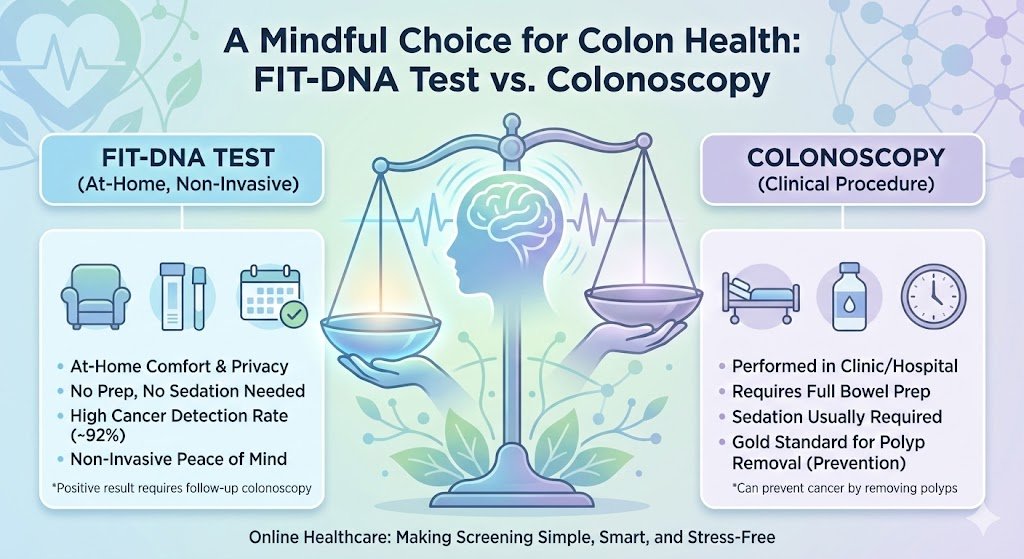
FIT-DNA Test vs Colonoscopy (Quick Comparison)
Here’s the simplest way to compare the FIT-DNA test vs colonoscopy:
- Colonoscopy: Most complete one-time exam. It can find polyps and remove them in the same visit. However, it needs bowel prep and usually sedation.
- FIT-DNA test: At-home stool test. It checks for hidden blood and DNA markers. Still, you must repeat it on schedule. If it’s positive, you need a colonoscopy next.
What Is a FIT-DNA Test (Stool DNA Test)?
A FIT-DNA test (stool DNA test) is an at-home screening option. It looks for:
- Hidden blood in stool (FIT)
- DNA changes linked with colorectal cancer and some advanced polyps
After you mail the sample, you get a result. Then, you review the next steps with a clinician.
What Is a Colonoscopy Test?
A colonoscopy is done in a clinic or hospital. A specialist uses a small camera to examine the colon. If a polyp is found, it can often be removed right away. Because of that, colonoscopy can help prevent cancer, not just detect it.
FIT-DNA Test vs Colonoscopy Accuracy (Which Is More Accurate?)
Why colonoscopy is usually the most accurate option
Colonoscopy lets a clinician view the colon directly. In addition, polyps can be removed during the same exam. Therefore, it is often considered the most thorough single screening test.
How accurate is a FIT-DNA test for screening?
FIT-DNA can detect many colorectal cancers. However, it may also show positive results when no cancer is present. As a result, some people will be sent to colonoscopy even when everything turns out normal.
Still, for average-risk adults, FIT-DNA is a strong way to start screening—especially if it helps you avoid delays.
Who Should Choose the FIT-DNA Test vs Colonoscopy?
Screening is personal. In other words, the right option depends on your risk and what you’ll realistically complete.
Choose the FIT-DNA test vs colonoscopy if you want an at-home option
FIT-DNA is often a good match when all of these are true:
- No symptoms right now
- Average risk (no high-risk history)
- Prefer at-home screening instead of a procedure
- Ready to book a colonoscopy if the FIT-DNA result is positive
Choose the colonoscopy vs FIT-DNA test if you want the most complete one-time exam
Colonoscopy is usually a better first step if any of these fit:
- Prefer one exam that can find and remove polyps
- Want longer gaps between screenings
- Had a positive stool test before and need a clear next step
When FIT-DNA Test vs Colonoscopy Is NOT a Choice (Colonoscopy Comes First)
Sometimes a stool test is not the right first step. Colonoscopy is usually recommended first if you:
- Have symptoms (blood in stool, unexplained anemia, ongoing bowel changes, unexplained weight loss)
- Have a strong family history or known high-risk conditions
- Had previous polyps or colorectal cancer
- Have inflammatory bowel disease (Crohn’s/ulcerative colitis)
If any of these apply, ask a clinician before choosing FIT-DNA.
FIT-DNA Test vs Colonoscopy Frequency (How Often?)
This is a major difference in the FIT-DNA test vs colonoscopy.
FIT-DNA test frequency
FIT-DNA needs repeat screening on a schedule (commonly every 1–3 years, depending on the guidelines and the clinician’s direction). If you miss repeats, protection drops.
Colonoscopy frequency
Screening colonoscopy is often repeated about every 10 years for average-risk adults with normal results (your clinician sets your interval).
What Happens If FIT-DNA Is Positive?
This is the most important rule in the entire FIT-DNA test vs colonoscopy discussion:
A positive FIT-DNA test must be followed by colonoscopy.
That colonoscopy confirms the result and allows removal of polyps if needed.
If someone does a FIT-DNA test but refuses follow-up colonoscopy when positive, screening becomes incomplete and risky.
Pros and Cons of FIT-DNA Test vs Colonoscopy
To make the decision easier:
FIT-DNA test pros
- At-home convenience
- No bowel prep
- No sedation
- Great option if colonoscopy anxiety causes delays
FIT-DNA test cons
- Positive result requires colonoscopy
- More false positives than some stool-only tests
- Must repeat regularly
Colonoscopy pros
- Most accurate single test
- Can remove polyps during the procedure
- Longer screening interval for normal results
- H3: Colonoscopy cons
- Bowel prep required
- Sedation and time off work
- Small procedure risks (your clinician explains these)
Checklist — How to Choose FIT-DNA Test vs Colonoscopy
Use this quick checklist:
- Prefer an at-home test? FIT-DNA may fit if you’re average risk and symptom-free.
- Want the most complete single exam? Colonoscopy is usually the best first choice.
- Need clarity after a positive result? A colonoscopy is required after any positive FIT-DNA test.
- Have symptoms or higher-risk history? Start with colonoscopy instead of stool testing.
- Worried you’ll delay screening? FIT-DNA can be a practical way to start now—then follow up if needed
Conclusion
For most people, the FIT-DNA test vs colonoscopy is not about which is “good” or “bad.” It’s about the best path you will complete. If you want the most accurate single test and polyp removal, choose colonoscopy. If you want an at-home option and will repeat it on schedule, and commit to a colonoscopy if positive, FIT-DNA can be a smart, practical alternative.
This article was reviewed and written with insights from the medical team at MindShape Clinic in the USA — experienced healthcare professionals specializing in cancer treatment, mental health, and patient wellness. Learn more about our board-certified doctors and treatment experts who contribute to our educational blogs and patient support programs.
Recent Blogs
Learn more about Virtual Healthcare and Treatments






Why You Can Rely on Us?
At Mindshape Clinic, we are committed to providing clear and trustworthy health information that you can rely on.
Reliable Information – Every article is based on credible sources.
Expert Review – Content is carefully checked before publishing.
Up to Date – We keep information current with the latest insights.
Clarity First – Our goal is to make knowledge simple and accessible.