Obsessive-compulsive disorder
Read Time: 9min
Written By

Dr. Hassan Khan
Internist
Obsessive-compulsive disorder (OCD) symptoms, causes, treatment
If you’re searching for answers about obsessive-compulsive disorder, you may be dealing with more than stress. You may be stuck in a loop of intrusive thoughts, fear, and repetitive behaviors that feel hard to stop.
Table of Contents
FAQs
Obsessive–Compulsive Disorder (OCD) FAQs
Please feel free to Send a Message or call us if your related question is not included here. we are happy to serve you.
There is no single first symptom for everyone. Many people first notice intrusive thoughts, repeated checking, reassurance-seeking, or mental rituals that increase over time. Mayo Clinic notes symptoms often begin gradually.
ERP therapy is a leading evidence-based treatment for OCD, and many people also benefit from medication or combined care. The best treatment plan depends on symptom severity, access to specialized care, and individual needs.
ERP for OCD means Exposure and Response Prevention. It’s a CBT-based therapy where you practice facing OCD triggers (exposure) without doing the usual ritual or compulsion (response prevention). This breaks the OCD cycle and teaches your brain that fear can pass without compulsions, reducing symptoms over time.
OCD usually improves with evidence-based treatment, not willpower alone. ERP therapy is a widely used first-line psychological treatment, and some people also benefit from medication. Over time, treatment can reduce the obsession-compulsion cycle and improve daily functioning.
Yes. , is one of the most effective therapies for OCD. It helps you face triggers gradually while resisting compulsions. Over time, anxiety drops naturally and urges become easier to manage. With consistent practice and support, many people see meaningful improvement in OCD symptoms and daily life.
Possible signs include intrusive thoughts, repeated rituals, frequent reassurance-seeking, and distress when routines are interrupted. However, only a licensed professional can diagnose OCD because symptoms can overlap with anxiety, trauma, and other conditions.
OCD and anxiety can overlap, but OCD includes a pattern of obsessions + compulsions. In contrast, general anxiety may involve worry without the same ritual-driven cycle.
There is no single root cause of obsessive–compulsive disorder. Instead, OCD is thought to involve a combination of factors such as genetics, brain circuitry, and environmental influences.
The major symptoms are obsessions (intrusive thoughts, urges, or images) and compulsions (repetitive behaviors or mental rituals). These symptoms are often time-consuming and distressing.
OCD can begin at any age, but it often starts between late childhood and young adulthood, according to NIMH. Mayo Clinic also notes it often begins in the teen or young adult years.
OCD is often mistaken for perfectionism, being organized, or general anxiety. The difference is that OCD involves intrusive obsessions and compulsive rituals that cause distress and interfere with life.
Fortunately, you should know that OCD is not a personality quirk. In fact, it is a real mental health condition that requires professional understanding. The National Institute of Mental Health (NIMH) describes OCD as a disorder involving uncontrollable thoughts (obsessions) and repetitive behaviors (compulsions).
In this guide, we explain OCD symptoms, causes, and treatments in plain language. Additionally, we cover how OCD differs from general anxiety and when you should seek professional help from our team at Mindshape Clinic.
What is obsessive-compulsive disorder (OCD)?
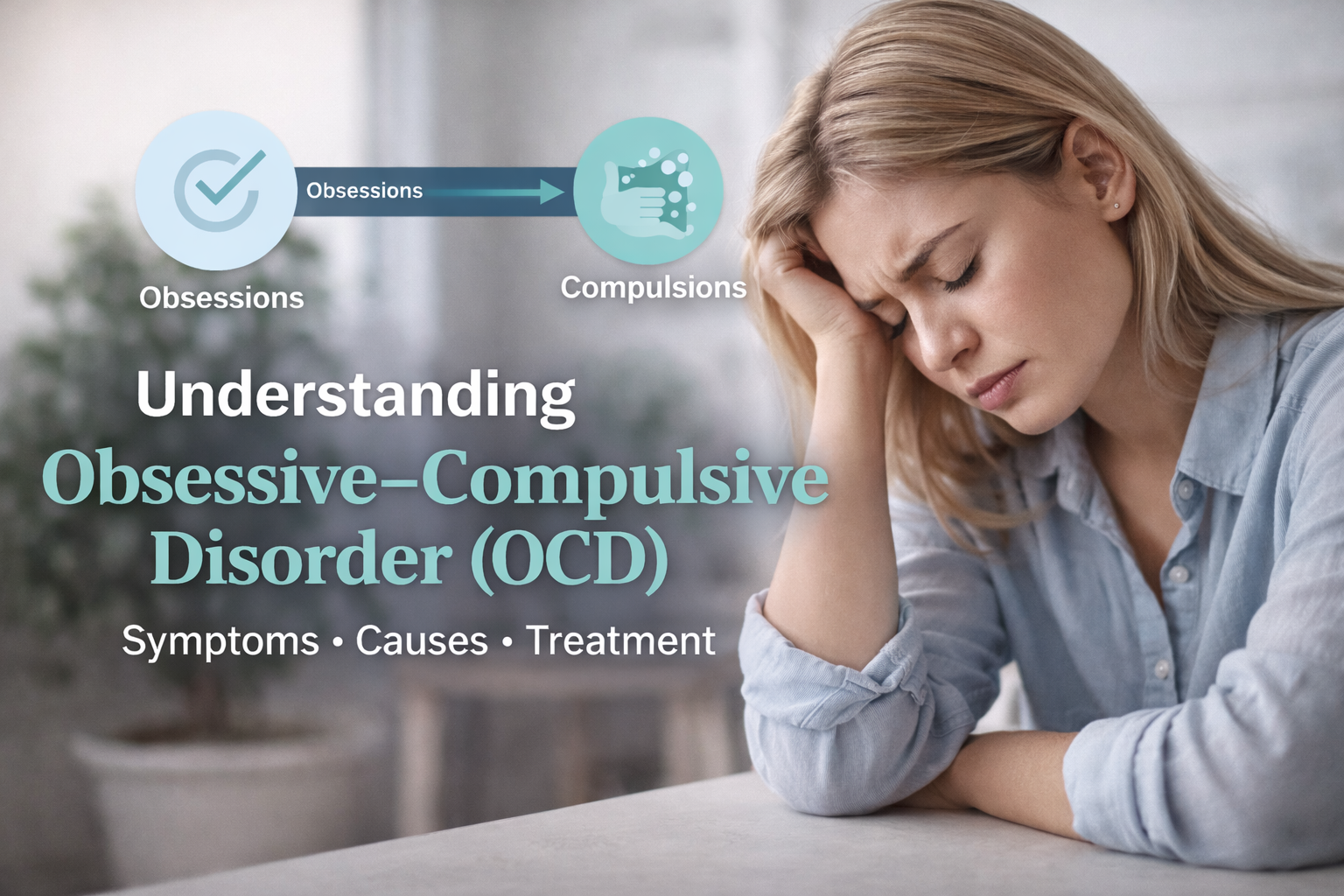
Broadly speaking, OCD is a mental health condition that involves two main components:
- Obsessions: Unwanted, intrusive thoughts, urges, or images.
- Compulsions: Repetitive behaviors or mental acts done to reduce distress.
According to the American Psychiatric Association (APA), these obsessions are recurring and unwanted. Consequently, a person feels driven to perform repetitive actions to find relief. For example, someone may fear contamination and wash their hands repeatedly. Similarly, another person may fear causing harm and check locks dozens of times.
Major symptoms of obsessive-compulsive disorder (OCD)
OCD symptoms usually fall into two categories. While some people experience both, others may have one type more strongly.
Obsessions (intrusive thoughts, urges, or images)
Obsessions are not just “worries.” Instead, they are intrusive and distressing. Common themes include:
- Fear of contamination from germs or illness.
- Intrusive thoughts about harming yourself or others.
- A desperate need for symmetry or things feeling “just right.”
- Excessive doubt, such as wondering if the stove was left on.
Common Compulsions (Repetitive Rituals)
Compulsions are actions performed to lower anxiety. However, the relief they provide is only temporary. Common behaviors include:
- Repeatedly washing hands or cleaning surfaces.
- Checking locks, appliances, or messages multiple times.
- Mental rituals like counting, praying, or silently repeating.
- Constantly seeking reassurance from loved ones.
What obsessive-compulsive disorder (OCD) in real life
In reality, OCD often looks different than common stereotypes. For instance, a person might spend an hour rereading a single email. Alternatively, they might avoid using knives because of intrusive harm thoughts.
Because of these symptoms, relationships, work, and sleep often suffer. Therefore, it is vital to recognize that these patterns are medical symptoms, not choices.
What is often mistaken for obsessive-compulsive disorder (OCD)?
Many people casually say “I’m so OCD” when they mean they are organized. Nevertheless, clinical OCD is much more intense. It is often mistaken for:
- General anxiety or “overthinking.”
- Perfectionism or being detail-oriented.
- Standard routine preferences.
The key difference is the presence of distress and impairment. In OCD, the thoughts feel intrusive, and the rituals feel mandatory. As a result, these symptoms interfere with daily life in a way that simple organization does not.
What causes obsessive–compulsive disorder (OCD)?
Many patients ask about the “root cause” of their symptoms. To be clear, OCD does not have a single cause. Instead, it is influenced by a mix of biological and environmental factors.
Biological and Genetic Factors
Research suggests that brain circuitry differences play a role. Specifically, how certain brain networks process fear and habits can be different in those with OCD. Furthermore, genetics and family history are significant contributors.
Environmental Stressors
In addition to biology, stressful life events can trigger or worsen symptoms. However, this does not mean a person “caused” their own disorder. Similarly, poor parenting is not a cause of OCD.
At what age does OCD usually start?
OCD can begin at almost any age. Typically, symptoms appear between late childhood and young adulthood. According to the Mayo Clinic, it often begins in the teenage years. Because symptoms can be subtle early on, they are sometimes missed by parents or teachers.
What is the first symptom of OCD?
There isn’t one universal “first symptom” for everyone. However, many people first notice one of these patterns:
- Intrusive thoughts that feel disturbing or repetitive
- Reassurance-seeking that starts to become frequent
- Checking behaviors that increase over time
- Cleaning/washing that feels hard to stop
- Mental rituals (counting, repeating, reviewing) that others may not see
In many cases, symptoms build gradually. Mayo Clinic notes that obsessive-compulsive disorder (OCD )symptoms often start over time and may vary in severity.
What is the difference between OCD and anxiety?
OCD and anxiety are related, but they are not the same thing.
How obsessive-compulsive disorder and anxiety overlap
Both can include:
- Fear
- Worry
- Physical tension
- Avoidance
- Trouble sleeping
How OCD is different from general anxiety
With OCD, the person often has:
- Specific intrusive obsessions
- Compulsive rituals (visible or mental)
- A strong urge to reduce uncertainty through repetition
In other words, anxiety may be part of OCD, but OCD includes a distinct obsession-compulsion cycle. If anxiety is one of your biggest symptoms, you may also find this helpful: How to Deal With Anxiety.
How to tell if someone has OCD
You cannot diagnose someone just by observing them. Still, there are common signs that may suggest obsessive-compulsive disorder and a need for evaluation.
Possible signs include:
- Spend a lot of time on repeated rituals
- Seem trapped in checking, cleaning, or counting routines
- Ask for reassurance again and again
- Avoid triggers intensely
- Become distressed if a ritual is interrupted
- Describe intrusive thoughts they do not want
However, only a licensed mental health professional can diagnose OCD. A proper evaluation matters because OCD can overlap with anxiety disorders, depression, trauma symptoms, tic disorders, and other conditions.
How obsessive-compulsive disorder is diagnosed
There is no single lab test for OCD. Diagnosis is usually made through a clinical assessment.
During an evaluation, a provider may ask about:
- Intrusive thoughts and their themes,
- Repetitive behaviors or mental rituals,
- How much time symptoms take,
- Distress level,
- Impact on work, school, and relationships,
and other mental health symptoms.
This step is important because treatment works best when it matches the person’s actual symptom pattern.
Best treatment for obsessive-compulsive disorder (OCD)
Fortunately, OCD is highly treatable. At Mindshape Clinic, we focus on evidence-based methods that provide long-term relief.
ERP therapy (Exposure and Response Prevention)
Currently, ERP is the gold standard for OCD. It involves facing your triggers without performing the ritual. Although this feels challenging at first, it eventually “retrains” your brain to stay calm without the compulsion.
In simple terms:
- Exposure = facing the trigger (gradually, with support)
- Response prevention = resisting the ritual/reassurance behavior
ERP can feel challenging at first. However, it helps many people reduce the OCD cycle over time.
Medication for obsessive-compulsive disorder (OCD)
Additionally, medication can be very helpful. It can lower the intensity of the thoughts so that therapy becomes easier to practice. At Mindshape Clinic, our board-certified doctors, like Dr. Hassan Khan, can help determine if medication is right for you.
Combined treatment (therapy + medication)
For many people, a combined approach works well. Therapy can help change the OCD cycle, while medication may lower symptom intensity enough to make practice easier.
That said, treatment is personal. Some people improve with ERP-focused therapy alone. Others benefit from both.
What helps obsessive-compulsive disorder (OCD) go away?
This is one of the top questions people ask, and it makes sense. When symptoms feel relentless, you want relief fast.
Here’s the honest answer: OCD usually does not disappear just because you “try harder” to stop thinking about it. In fact, fighting intrusive thoughts directly can sometimes make them feel stronger.
What helps most is evidence-based treatment, especially ERP therapy, and sometimes medication. IOCDF and Mayo Clinic both point to these as key treatment paths.
Also, early treatment often leads to better outcomes because symptoms have less time to become deeply reinforced habits.
What is the 15-minute rule in OCD?
The “15-minute rule” is commonly used as a coping strategy, not a formal diagnostic rule. People often use it to delay a compulsion or reassurance behavior for a short time (such as 10–15 minutes) to reduce automatic ritualizing.
For example:
- “I want to check the lock again.”
- “I will wait 15 minutes first.”
This can help create a pause. It may also help a person notice urges without acting right away.
However, this strategy is not a substitute for treatment. It works best as part of a structured plan, especially ERP-informed treatment, because OCD can quickly “work around” self-help tricks without guidance. IOCDF’s ERP framework is the stronger long-term approach.
Practical steps that can help while you seek treatment
These steps will not replace professional care. Still, they can support progress.
1) Track your obsessive-compulsive disorder (OCD) pattern
Write down:
- Trigger
- Obsession theme
- Compulsion
- Short-term relief
- Later consequence
This helps you see the cycle more clearly.
2) Reduce reassurance loops
Reassurance can feel calming in the moment. However, repeated reassurance often feeds OCD over time.
Try noticing when you ask:
- “Are you sure?”
- “Do you think I’m okay?”
- “Did I do something wrong?”
3) Build basics that support your nervous system
Simple habits matter:
- Regular sleep
- Meals
- Hydration
- Movement
- Lower caffeine (if it worsens anxiety)
4) Get support early
If symptoms are growing, don’t wait for a “perfect moment.” Early help can make treatment easier to start and sustain.
If you’re also trying to understand overlapping symptoms, this guide may help: Recognizing Early Signs of Stress, Anxiety, and Depression.
When to seek professional help for OCD
It’s time to seek help if obsessive–compulsive disorder symptoms are:
- Taking a lot of time each day,
- Causing distress,
- Affecting work or school,
- Straining relationships,
- Disrupting sleep,
- Or making daily life feel smaller.
You do not need to “prove” your symptoms are severe enough. If OCD is affecting your peace of mind, support is appropriate.
When it may be urgent
Seek urgent help right away if there are:
- Thoughts of self-harm or suicide,
- Inability to stay safe,
- Or a mental health crisis.
If you are in the U.S.:
- Call 911 for immediate emergency help
- Call or text 988 for crisis support
Ready to get support?
If OCD symptoms are affecting your daily life, book an appointment to talk with a licensed mental health provider. Early support can help you understand your symptoms, start a treatment plan, and feel more in control.
A caring note from MindShape Care
This article is for education only and is not a diagnosis. If your symptoms feel severe, urgent, or unsafe, please seek immediate emergency or crisis support.
This article was reviewed and written with insights from the medical team at MindShape Clinic in the USA — experienced healthcare professionals specializing in cancer treatment, mental health, and patient wellness. Learn more about our board-certified doctors and treatment experts who contribute to our educational blogs and patient support programs.
Recent Blogs
Learn more about Virtual Healthcare and Treatments






Why You Can Rely on Us?
At Mindshape Clinic, we are committed to providing clear and trustworthy health information that you can rely on.
Reliable Information – Every article is based on credible sources.
Expert Review – Content is carefully checked before publishing.
Up to Date – We keep information current with the latest insights.
Clarity First – Our goal is to make knowledge simple and accessible.