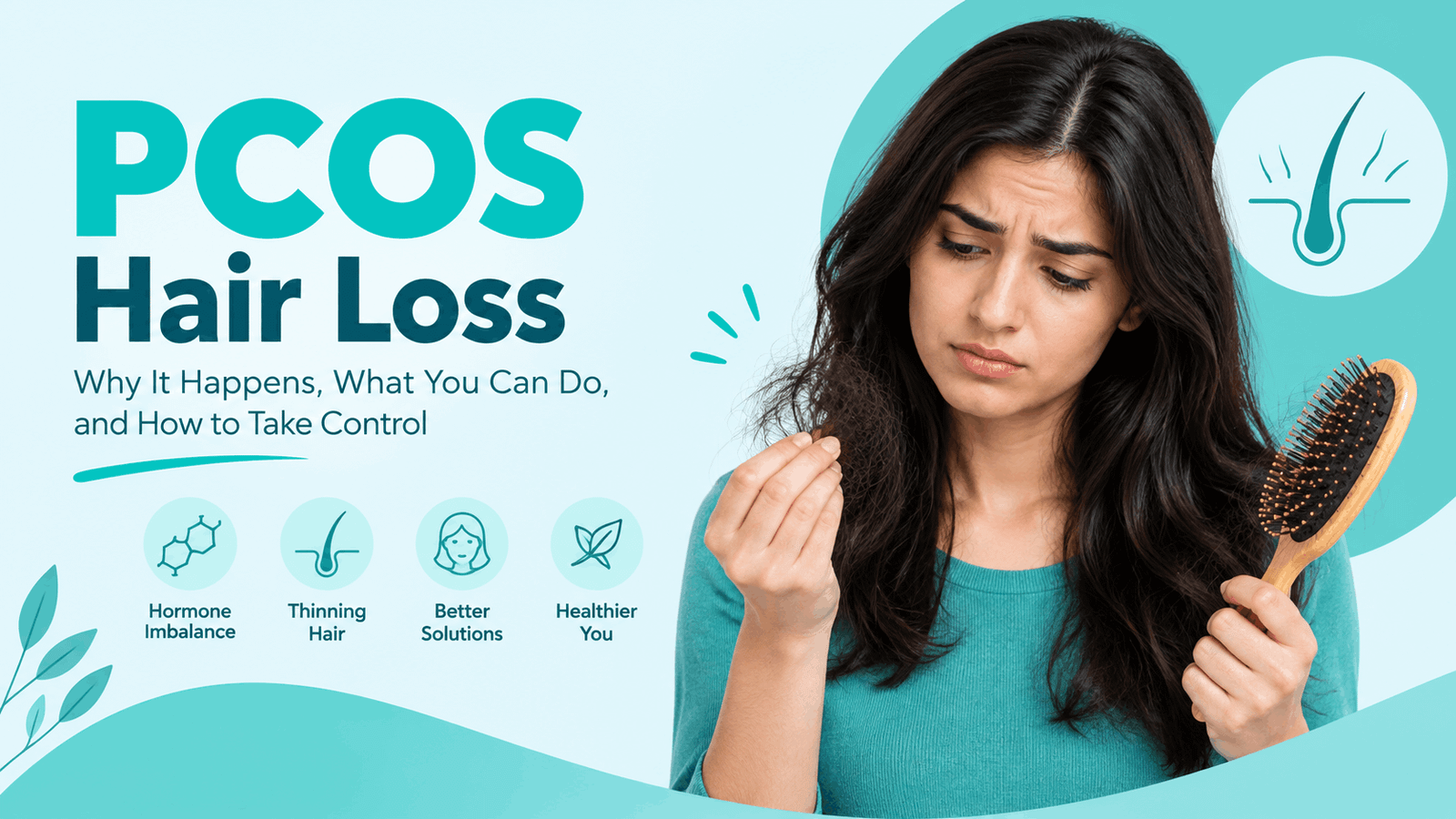
PCOS Hair Loss
PCOS Hair Loss Treatment: Why PCOS Can Cause Hair Loss & What Can Help
Written by:

Mindshape Content Team
Medically Reviewed by:

If you have PCOS, hair loss can feel like one more symptom on a long list. It’s also one of the more confusing ones, because it’s not usually the first thing anyone mentions when PCOS comes up. Irregular periods get discussed. Acne gets discussed. Thinning hair often doesn’t, even though it’s common.
Here’s the short version: PCOS hair loss has a real, well-understood cause, and it responds to treatment, just not always a fast or simple one. This guide covers why it happens, how it’s diagnosed, and what actually helps. We list every source at the end so you can check it yourself.
PCOS can cause hair loss because it raises androgen levels: hormones like testosterone and DHT. The insulin resistance common in PCOS makes that worse. The result usually looks like ordinary female pattern hair loss, with gradual thinning on top rather than a receding hairline. Diagnosis rests on confirming PCOS itself, plus ruling out other causes. Treatment usually works on two fronts at once: the hair directly topical minoxidil, sometimes an anti-androgen and the PCOS itself managing insulin resistance, sometimes hormonal birth control.
How Common Is Hair Loss in PCOS?
A 2019 report from a multidisciplinary group that included the Androgen Excess and PCOS Society looked at this question directly. It’s the closest thing this topic has to an official consensus statement. Other sources summarizing that report put the number at roughly 20 to 30% of people with PCOS.
That’s a meaningful share, but it also means most people with PCOS don’t develop it. If you have PCOS and your hair is thinning, something specific is happening with your androgen levels. It’s not an inevitable part of having the condition.
Why Can PCOS Cause Hair Loss?
The androgen connection
PCOS is, at its core, a condition of excess androgens. That’s testosterone and its more potent relative, dihydrotestosterone (DHT). Scalp hair follicles on the top of the head are sensitive to DHT in people who are genetically prone to it. Over time, DHT shrinks those follicles. They produce thinner, shorter hairs with each cycle. That’s the same basic process behind female pattern hair loss in general; PCOS just means the androgen side of the equation runs higher than it otherwise would.
The insulin resistance connection
Insulin resistance is extremely common in PCOS. It matters here for two reasons. First, high insulin levels push the ovaries to produce more androgens directly. Second, insulin resistance lowers a protein called SHBG, which normally binds up androgens in the bloodstream and keeps them inactive. Less SHBG means more free, active androgen reaching the hair follicle. Both effects point the same direction: more hair loss.
This is also why lifestyle changes that improve insulin sensitivity, not just medications aimed at the scalp, show up repeatedly in PCOS hair loss treatment.
Why it doesn’t always look the same from person to person
Not everyone with PCOS has the same androgen levels, and not every follicle responds to DHT equally. That’s part of why hair loss shows up in some people with PCOS and not others, and why its severity varies so much.
What Does PCOS Hair Loss Actually Look Like?
Hair loss in women with PCOS mostly looks like ordinary female pattern hair loss, not something visually distinct on its own. It thins out the top of the scalp over time, while the front hairline generally holds its ground, a different shape than the receding hairline more typical in men. Two companion guides cover related ground. Women Hair Loss explains how this pattern compares to male hair loss. Hair Loss Treatment for Women covers the fuller diagnostic workup for hair loss in women generally. Neither is specific to PCOS and hair loss together, which is what this guide is for.
What’s different with PCOS isn’t usually the pattern on the scalp. It’s what tends to come with it: irregular or absent periods, acne, and unwanted hair growth elsewhere on the face or body, known as hirsutism. If thinning hair is showing up alongside any of those, PCOS is worth asking about directly.
How Is PCOS-Related Hair Loss Diagnosed?
This actually involves two separate questions: does this person have PCOS, and is the hair loss connected to it. Both get worked through.
Confirming PCOS itself
PCOS is diagnosed using the Rotterdam criteria. A 2024 review in the Journal of Obesity & Metabolic Syndrome lays these out clearly. A diagnosis requires two of these three features, after other causes are ruled out.
- Irregular or absent ovulation (irregular or missing periods)
- Clinical or biochemical signs of excess androgens (hirsutism, acne, or elevated androgens on a blood test)
- Polycystic-appearing ovaries on ultrasound
You don’t need all three. A person can be diagnosed with PCOS from irregular periods and high androgens alone, with a normal-looking ultrasound, or from any other combination of two.
Confirming the hair loss is androgen-related
The 2019 multidisciplinary committee report is direct about this part. In anyone with female pattern hair loss, checking for androgen excess is a standard step, not an optional one. That usually means blood tests for total and free testosterone, and sometimes DHEA-sulfate. Thyroid function and iron levels are often checked too, since those can cause or worsen shedding independently of PCOS.
A clinician will also ask about timing. Hair loss that tracks with your cycle irregularity or started around the same time as other PCOS symptoms points more clearly toward PCOS as the driver. Hair loss with a completely different timeline might have a separate cause worth chasing down on its own.
| Comparison | Without PCOS | With PCOS |
|---|---|---|
| What's Usually Happening | Genetic sensitivity to normal androgen levels. | Genetic sensitivity, plus elevated androgens, often worsened by insulin resistance. |
| Other Symptoms | Often none. | Often irregular periods, acne, or excess facial/body hair. |
| Workup | History, scalp exam, and routine labs (thyroid, ferritin). | The above, plus an androgen panel and PCOS evaluation (Rotterdam criteria). |
| Treatment Focus | Hair directly (minoxidil, sometimes an anti-androgen). | Hair treatment and underlying PCOS management (insulin resistance, sometimes hormonal birth control). |
PCOS Hair Loss Treatment: What Can Help
Treatment generally works on two fronts: the hair itself, and the PCOS driving it.
Topical minoxidil
Topical minoxidil is the same first-line, FDA-approved option used for female pattern hair loss generally, and PCOS doesn’t change that. A 2% solution or 5% foam, applied directly to the scalp, with visible results typically taking four to six months. It works regardless of what’s driving the excess androgen; it doesn’t require sorting out the PCOS first.
Addressing insulin resistance
Because insulin resistance amplifies the androgen problem, improving it can help the hair loss indirectly. This is usually approached through diet and exercise first, and sometimes metformin, a medication that improves insulin sensitivity. Metformin isn’t an anti-androgen itself, and it isn’t a direct hair treatment. Its role here is upstream. Less insulin resistance can mean lower androgen levels over time. That can mean less of the signal driving the hair loss in the first place.
Anti-androgens
Spironolactone, used off-label, blocks androgen activity directly and is a common addition when hair loss is clearly androgen-driven. The evidence specifically for hair, as opposed to acne or excess hair growth, is more limited than you’d expect given how often it’s prescribed.
Combined oral contraceptives
Hormonal birth control is frequently recommended for PCOS, and it does lower ovarian androgen production. Here’s the honest caveat: most of the evidence for its benefit on hirsutism and acne is solid. The evidence specifically for scalp hair regrowth is thinner, and much of what’s cited comes from general population studies rather than PCOS-specific trials. It’s a reasonable piece of a broader plan, especially if you also need contraception or cycle regulation. It’s just not a guaranteed fix for the hair on its own.
The hirsutism trade-off worth knowing about
Here’s a nuance specific to PCOS that a generic hair-loss guide won’t mention. A 2022 clinical review points out something worth knowing here. Treatment aimed at promoting scalp hair growth can, in some cases, work against treatment for unwanted facial or body hair. Both are responding to the same androgen pathway, just in opposite directions on different parts of the body. This isn’t a reason to avoid treating either one. It’s a reason to have both goals on the table in the same conversation with your clinician, rather than treating them as unrelated.
Where “natural remedies” fit
Zinc, inositol, and similar supplements show up often in PCOS hair loss content. They may support general hormonal balance as part of a broader plan, but they’re adjuncts, not substitutes for addressing the androgen and insulin resistance pieces directly. If a page promises a supplement will reverse PCOS hair loss on its own, that’s a bigger claim than the evidence supports.
How MindShape Approaches PCOS-Related Hair Loss
At MindShape, a licensed clinician looks at your whole picture in a video visit: your cycle history, other PCOS symptoms, and relevant labs, not just the hair. From there, treatment usually addresses both the scalp and the underlying PCOS together. That might mean topical minoxidil alongside support for insulin resistance. It might also mean a referral for further hormone workup if you haven’t been formally diagnosed with PCOS yet.
Our clinicians are internal medicine physicians and advanced practice clinicians, not dermatologists, which fits well here since PCOS is fundamentally a hormonal and metabolic condition. You can read more about our PCOS care, or how our Online Hair Loss Treatment works.
Start With Confirming the Cause
PCOS hair loss has a real mechanism behind it, which means it has a real treatment approach, not just a list of things to try. The most useful first step is confirming that PCOS is actually what’s driving it, and ruling out anything else that might also be contributing.
If you’d like help working through that, schedule a video visit with a MindShape clinician.
FAQs
Frequently Asked Questions
Does PCOS cause hair loss?
Pattern hair loss, also called female pattern hair loss, tops the list. The part widens and the crown thins while the frontal hairline usually holds its ground, and the odds of it happening increase with age, especially after menopause.
Is PCOS hair loss reversible?
Shedding that started a few months after an illness, childbirth, surgery, or a major weight change is usually temporary telogen effluvium. It tends to resolve within six to nine months once the trigger passes. Gradual thinning with no clear trigger is more likely pattern hair loss, which is manageable but doesn’t reverse entirely on its own. A clinician can usually tell the difference from your history alone.
Will losing weight help PCOS hair loss?
The most common blood test for hair loss in women checks ferritin, for iron stores, along with thyroid function. A vitamin D level or hormone panel gets added if your history suggests PCOS or another androgen-related cause. Ferritin is the one worth a second look if your result comes back “normal.” The standard lab cutoff is lower than what many hair-loss specialists consider adequate for hair specifically.
Will birth control fix PCOS hair loss?
It depends on the cause. Hair loss triggered by an iron deficiency, a thyroid problem, or childbirth often improves substantially once that cause is addressed. Pattern hair loss doesn’t have a cure, but it can usually be slowed, and often partly regrown, with consistent treatment. The benefit fades if treatment stops.
What doctor should I see for PCOS hair loss?
Usually not, but sometimes yes. Thyroid disease and PCOS are common, manageable causes. A receding hairline, scalp redness or scaling, or rapidly progressing patchy loss can signal a scarring condition or alopecia areata. Both are worth a dermatologist’s attention sooner rather than later.
Is spironolactone safe for PCOS hair loss?
A general or internal medicine clinician can evaluate the common causes, order the standard labs, and start topical or oral minoxidil. Round bald patches, a hairline on the move, a sore or scaly scalp, or loss that’s advancing within days rather than months call for an in-person dermatologist. Those situations sometimes need a hands-on exam or a biopsy.
This article is for informational and educational purposes only and is not a substitute for professional medical advice, diagnosis, or treatment. If you are experiencing a medical emergency or a mental health crisis, please seek immediate care from emergency services or a local crisis line. This content has been written and reviewed by the Medical Team at mindshape.care. Read our full Medical Disclaimer.
References
View Clinical Sources & References
MindShape is dedicated to providing you with accurate and trustworthy health information.
- Carmina E, Azziz R, Bergfeld W, et al. Female Pattern Hair Loss and Androgen Excess: A Report From the Multidisciplinary Androgen Excess and PCOS Committee. Accessed on September 30, 2026 at https://doi.org/10.1210/jc.2018-02548.
- Female Pattern Hair Loss and Polycystic Ovarian Syndrome: More Than Just Hirsutism. Accessed on September 30, 2026 at https://pubmed.ncbi.nlm.nih.gov/36226726/.
- National Library of Medicine, PMC. Diagnostic Criteria for Polycystic Ovary Syndrome, Journal of Obesity & Metabolic Syndrome. Accessed on September 30, 2026 at https://pmc.ncbi.nlm.nih.gov/articles/PMC11704221/.
- Herskovitz I, Tosti A. Female Pattern Hair Loss. Accessed on September 30, 2026 at https://brieflands.com/journals/ijem/articles/17638.
- Olsen EA, Sinclair R, Hordinsky M, et al. Summation and Recommendations for the Safe and Effective Use of Topical and Oral Minoxidil. Accessed on September 30, 2026 at https://escholarship.org/uc/item/5d42s0q7.
- National Library of Medicine, MedlinePlus. Androgenetic Alopecia. Accessed on September 30, 2026 at https://medlineplus.gov/genetics/condition/androgenetic-alopecia/.
Recent Blogs
Explore More Hair Loss Treatment or Care

Why You Can Rely on Us?
At Mindshape Clinic, we are committed to providing clear and trustworthy health information that you can rely on.
Reliable Information – Every article is based on credible sources.
Expert Review – Content is carefully checked before publishing.
Up to Date – We keep information current with the latest insights.
Clarity First – Our goal is to make knowledge simple and accessible.