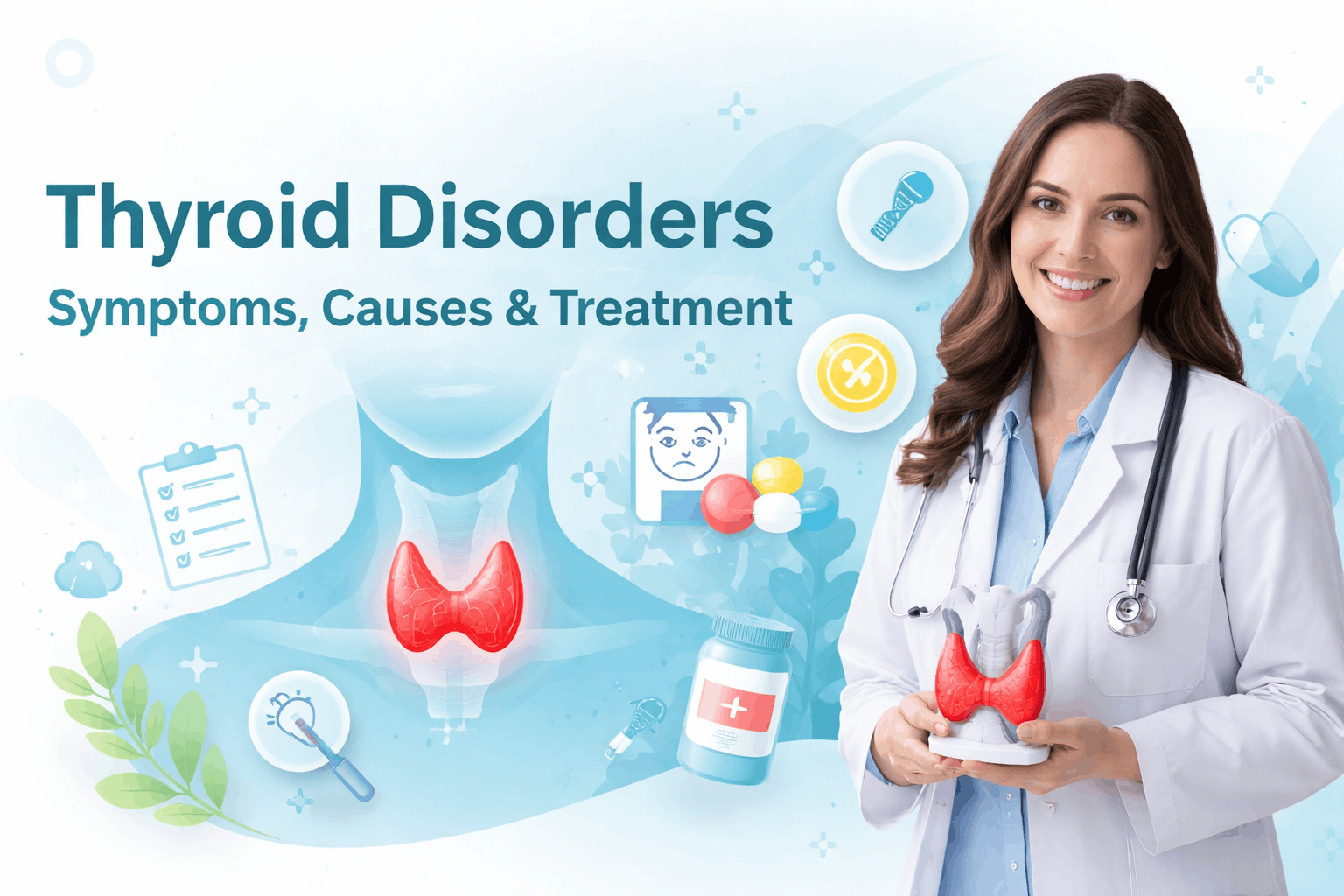
Thyroid Disorders
Read Time: 8min
Written By

Dr. Hassan Khan
Internist
Thyroid Disorders: Explained, Symptoms, Causes, and Treatment
If your energy is gone, your mood feels different, or your weight keeps changing, it’s easy to blame stress. However, those symptoms can also be linked to your thyroid.
Table of Contents
FAQs
Thyroid Disorders FAQs
Please feel free to Send a Message or call us if your related question is not included here. we are happy to serve you.
Autoimmune disease (Hashimoto’s, Graves’), inflammation, genetics, pregnancy-related changes, and iodine imbalance can contribute.
Fatigue, weight change, temperature sensitivity, hair/skin changes, mood shifts, sleep problems, and heart rate changes are common early signs.
It can affect energy, metabolism, heart rate, mood, digestion, and reproductive health. Untreated disease can lead to complications over time.
Hypothyroidism often includes fatigue, weight gain, cold intolerance, and dry skin. Hyperthyroidism often includes weight loss, rapid heartbeat, tremors, and sweating.
It may show up as fatigue, hair thinning, weight change, mood changes, and irregular or heavy periods.
Common signs include low energy, brain fog, hair changes, temperature sensitivity, and menstrual changes.
It can be serious when untreated. However, most people do well with diagnosis, monitoring, and the right plan.
Hypothyroidism, hyperthyroidism, Hashimoto’s, Graves’, thyroiditis, goiter, nodules, and thyroid cancer are common thyroid conditions.
It may cause fatigue, sleep issues, mood changes, weight shifts, and heart rate changes. Testing helps confirm the cause.
Thyroid Disorders can affect metabolism, heart rate, sleep, digestion, and temperature control. Because the symptoms are broad, many people in the USA live with thyroid disease longer than they need to.
In this guide, we break down Thyroid Disorders in plain language. We cover symptoms, causes, testing, and treatment. We also explain thyroid medication basics and what to do if work is affected.
What are Thyroid Disorders?
Thyroid Disorders are conditions that affect your thyroid gland and thyroid hormone levels. The thyroid is a small gland in the front of the neck. Even so, it influences the entire body.
When thyroid hormone levels are too low or too high, the body can feel “off.” For example, you may feel exhausted and cold. Or you may feel jittery and overheated. Cleveland Clinic explains that thyroid disease can affect many body functions, including metabolism.
Thyroid diseases list (most common types)
Many people search “Thyroid diseases list” because there are several conditions under one umbrella. So, here’s the simple version.
Hypothyroidism (underactive thyroid)
Hypothyroidism means the thyroid does not make enough hormone. Symptoms often build slowly. That’s why many people miss the early signs. NIDDK lists fatigue, weight gain, cold intolerance, dry skin, hair thinning, depression, and menstrual changes as common symptoms.
Hyperthyroidism (overactive thyroid)
Hyperthyroidism means the thyroid makes too much hormone. Mayo Clinic notes that treatment options include anti-thyroid medicines, radioiodine, and surgery in some cases.
Hashimoto’s disease and Graves’ disease
Hashimoto’s and Graves’ are common autoimmune thyroid conditions. Hashimoto’s often leads to hypothyroidism over time. Graves’ is a common cause of hyperthyroidism.
Thyroiditis, goiter, and nodules
Thyroiditis is inflammation of the thyroid. A goiter is thyroid enlargement. Nodules are lumps in the thyroid. Many nodules are benign. Still, some need follow-up testing.
Thyroid cancer (important, but less common)
Most thyroid lumps are not cancer. Still, people worry about thyroid cancer for good reason. The National Cancer Institute describes thyroid cancer treatments such as surgery and radioactive iodine therapy, depending on the type and stage.
Early warning signs of thyroid problems
Early signs can be subtle. In addition, they can mimic burnout.
Here are common early warning signs linked to Thyroid Disorders:
- Fatigue that doesn’t improve with rest
- Weight gain or weight loss without a clear reason
- Feeling unusually cold or unusually hot
- Dry skin, hair thinning, or brittle hair
- Brain fog, low focus, or forgetfulness
- Mood shifts, including low mood or irritability
- Sleep changes (insomnia or too much sleep)
- Heart rate changes (slow, fast, or pounding)
- Constipation or diarrhea
NIDDK highlights fatigue, weight gain, cold intolerance, dry skin/hair changes, and menstrual/fertility changes as common hypothyroidism symptoms.
What thyroid disease can do to a person?
Thyroid hormones affect many systems. As a result, symptoms can show up in unexpected ways.
Thyroid Disorders may affect:
- Energy: fatigue or restlessness
- Heart: slowed pulse or rapid heartbeat
- Metabolism: weight changes and temperature sensitivity
- Mood: anxiety, irritability, low mood
- Digestion: constipation or diarrhea
- Sleep: insomnia or excessive sleepiness
- Skin and hair: dryness, thinning hair, puffiness
- Reproductive health: cycle changes and fertility issues for some people
So, if multiple symptoms are happening together, thyroid testing may be worth it.
Symptoms in females
Thyroid disease is more common in women. Because hormones interact, symptoms can show up in reproductive health.
Common thyroid symptoms in females may include:
- Irregular or heavy periods
- Fatigue and brain fog
- Hair thinning or dryness
- Weight changes
- Mood changes
- Fertility concerns in some cases
If symptoms shift after pregnancy or during major hormonal changes, it’s smart to ask about thyroid labs.
Symptoms in males
Thyroid symptoms in males can look like stress or sleep issues. However, thyroid imbalance can also affect energy and mood.
Men may notice:
- Persistent fatigue
- Sleep disruption
- Weight changes
- Mood changes
- Heart rate shifts
If symptoms last a few weeks and don’t improve, labs can provide clarity.
Thyroid disease causes (what triggers it?)
People often ask for a single cause. However, Thyroid Disorders usually develop from a mix of factors.
Common causes and risk factors include:
- Autoimmune disease (Hashimoto’s, Graves’)
- Family history of thyroid disease
- Inflammation (thyroiditis)
- Pregnancy/postpartum changes (in some cases)
- Iodine imbalance (too low or too high)
- Certain medications (your clinician can review these)
The key point: thyroid disease is a medical condition. It is not a personal failure.
Is thyroid disease dangerous?
It can be serious if untreated. Still, many people do well with testing and treatment.
For example:
- Mayo Clinic notes untreated hypothyroidism can contribute to problems such as high cholesterol and heart issues over time.
- Hyperthyroidism can affect the heart and cause significant symptoms, so evaluation matters.
If symptoms are strong or worsening, don’t wait.
How Thyroid Disorders are diagnosed (tests that matter)
Thyroid testing is usually straightforward. In the USA, clinicians often start with bloodwork.
Common thyroid lab tests
- TSH (thyroid-stimulating hormone)
- Free T4
- Sometimes Free T3
After that, providers may add antibody tests to check autoimmune thyroid disease. They may also order an ultrasound if nodules or swelling are suspected.
What labs can help confirm
For example, Mayo Clinic notes hypothyroidism is commonly treated after diagnosis, often using lab testing and follow-up monitoring. In other words, labs guide both diagnosis and dose adjustments.
Thyroid Disorders treatment options
Treatment depends on the type of thyroid problem. So, diagnosis comes first.
Thyroid medication for hypothyroidism
Hypothyroidism is commonly treated with thyroid hormone replacement. Levothyroxine is a standard option described by the American Thyroid Association and Mayo Clinic.
What to expect:
Many people start to feel better within weeks. Then, providers adjust the dose based on follow-up TSH testing.
Hyperthyroidism treatment options
Hyperthyroidism can be treated with:
- Anti-thyroid medicines
- Radioiodine therapy
- Surgery in selected cases
A provider chooses the path based on cause, severity, and overall health.
Thyroid cancer treatment (high-level overview)
Thyroid cancer treatment may include surgery, radioactive iodine therapy, thyroid hormone therapy, and other approaches depending on cancer type and stage. NCI outlines these treatment categories.
If you have a neck lump, hoarseness, trouble swallowing, or swollen lymph nodes, ask a clinician for evaluation.
Practical checklist (when to book an appointment)
If you suspect Thyroid Disorders, this checklist can guide your next step.
Book an evaluation if you have
- Fatigue plus weight change
- Temperature sensitivity plus sleep issues
- Hair thinning plus dry skin
- Heart rate changes (fast or slow)
- Mood shifts that feel new or intense
- Menstrual changes or fertility concerns
- Symptoms lasting more than 3–6 weeks
Bring this to your visit
Symptom timeline
- Medications and supplements
- Family thyroid history
- Prior labs (if you have them)
- Any recent pregnancy or major life change
This makes care more accurate. It also reduces delays.
If thyroid disorder symptoms are making everyday life feel harder than it should, we’re here for you. Book an appointment to speak with a licensed provider who will listen, take your concerns seriously, and guide you through the next steps. With the right labs and a clear plan, many people start feeling more like themselves again steadier, more energized, and more in control.
A caring note from MindShape Care
This article is for education only and is not a diagnosis. If your symptoms feel severe, urgent, or unsafe, please seek immediate emergency or crisis support.
This article was reviewed and written with insights from the medical team at MindShape Clinic in the USA — experienced healthcare professionals specializing in cancer treatment, mental health, and patient wellness. Learn more about our board-certified doctors and treatment experts who contribute to our educational blogs and patient support programs.
Recent Blogs
Learn more about Virtual Healthcare and Treatments





Why You Can Rely on Us?
At Mindshape Clinic, we are committed to providing clear and trustworthy health information that you can rely on.
Reliable Information – Every article is based on credible sources.
Expert Review – Content is carefully checked before publishing.
Up to Date – We keep information current with the latest insights.
Clarity First – Our goal is to make knowledge simple and accessible.