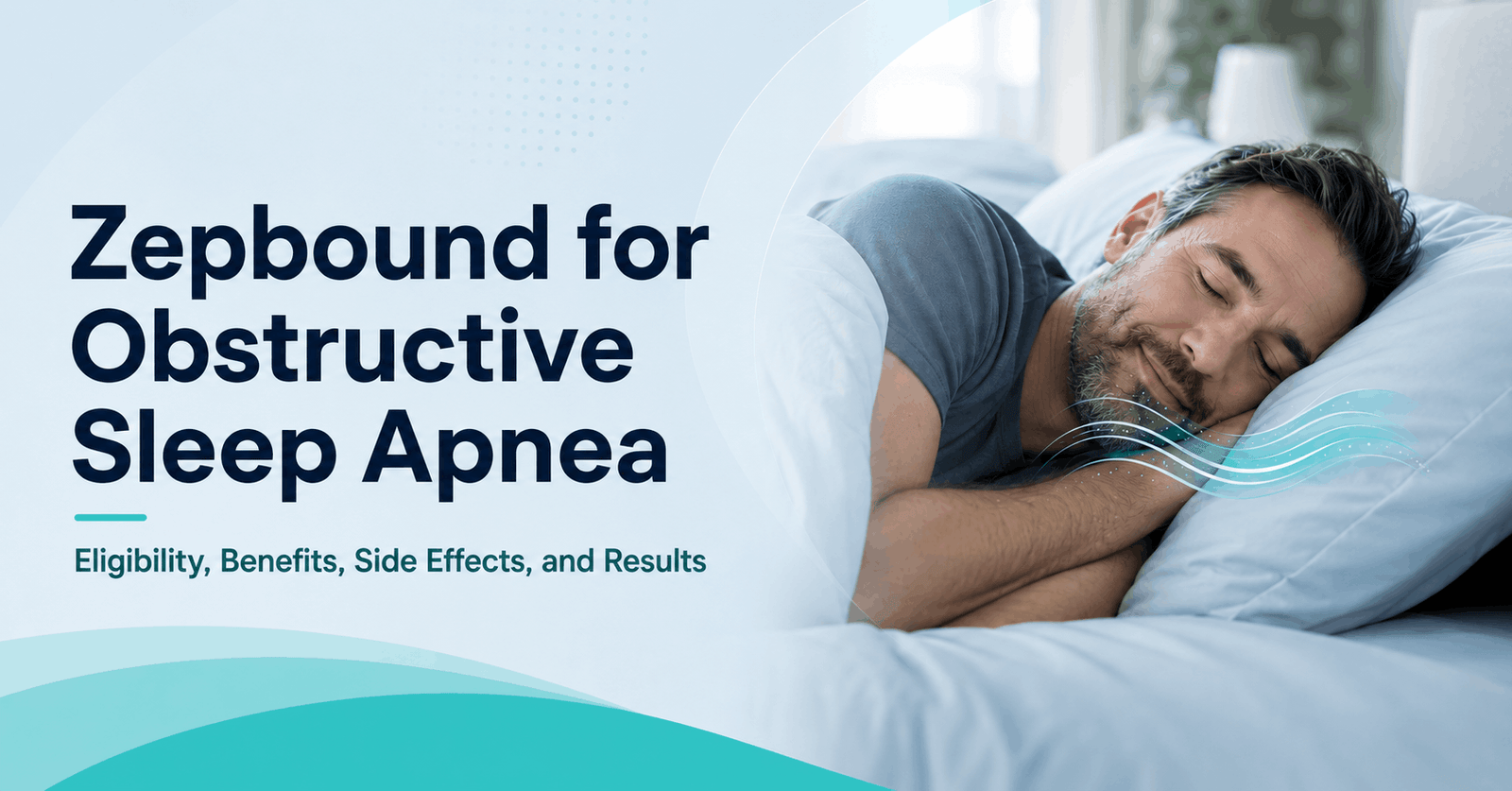
Zepbound for Sleep Apnea
Zepbound for Sleep Apnea: How It Works, Who Qualifies, and What to Expect
Written by:

Mindshape Content Team
Medically Reviewed by:

Zepbound (tirzepatide) is FDA-approved, with a reduced-calorie diet and increased physical activity, to treat moderate-to-severe obstructive sleep apnea in adults with obesity. In two 52-week trials, it reduced breathing interruptions and body weight more than placebo. It does not automatically replace CPAP, and it has important risks and contraindications.
Obstructive sleep apnea and obesity often occur together. Zepbound gives clinicians a medication option that can address excess body weight while also improving OSA severity in eligible adults. It is not a treatment for every form of sleep apnea, and the response varies from person to person.
This guide explains who the FDA approval covers, what the clinical trials found, how Zepbound differs from similar medications, and what to discuss with your healthcare provider before changing treatment.
What Is Zepbound?
Zepbound is a brand name for tirzepatide, a once-weekly prescription injection. Tirzepatide activates GIP and GLP-1 receptors involved in appetite and food intake. This can produce substantial weight loss when treatment is combined with nutrition and physical-activity changes.
In December 2024, the U.S. Food and Drug Administration approved Zepbound to treat moderate-to-severe OSA in adults with obesity. It was the first medication to receive a specific FDA indication for OSA. The improvement in breathing events is likely related to the reduction in body weight.
How Does Zepbound Help With Sleep Apnea?
OSA occurs when the upper airway repeatedly narrows or closes during sleep. Excess body weight can contribute through fat around the tongue and upper airway, changes in chest and abdominal mechanics, and other metabolic effects. Losing weight can reduce these pressures and lower the number of breathing interruptions during sleep.
Zepbound does not hold the airway open in the way CPAP does. It works gradually by helping reduce body weight. OSA also has non-weight-related causes, including airway anatomy, neuromuscular control and nasal obstruction, so weight loss does not eliminate OSA for everyone.
What Did the SURMOUNT-OSA Trials Find?
The FDA approval was based on two randomized, double-blind, placebo-controlled phase 3 trials involving 469 adults with obesity and moderate-to-severe OSA. Participants did not have type 2 diabetes. One trial enrolled people who were unable or unwilling to use positive airway pressure (PAP); the other enrolled people who were using PAP. Everyone received guidance on a reduced-calorie diet and increased physical activity.
Participants received placebo or their maximum tolerated Zepbound dose of 10 mg or 15 mg once weekly for 52 weeks. The primary outcome was the change in apnea-hypopnea index, or AHI—the number of apnea and hypopnea events per hour of sleep.
| Result at Week 52 | Not Using PAP | Using PAP |
|---|---|---|
| AHI change with Zepbound | −25.3 events/hour | −29.3 events/hour |
| AHI change with placebo | −5.3 events/hour | −5.5 events/hour |
| Body-weight change with Zepbound | −17.7% | −19.6% |
| Body-weight change with placebo | −1.6% | −2.3% |
| Remission or mild non-symptomatic OSA | 42.2% vs. 15.9% placebo | 50.2% vs. 14.3% placebo |
These are group averages, not a prediction for an individual patient. Some participants had a large improvement, while others continued to have clinically important OSA after treatment.
Who Qualifies for Zepbound for Sleep Apnea?
The FDA-approved OSA indication covers adults with obesity and moderate-to-severe obstructive sleep apnea. In the clinical trials, obesity was defined as a BMI of at least 30 kg/m² and moderate-to-severe OSA as an AHI of at least 15 events per hour.
A typical evaluation therefore considers:
- Age 18 or older.
- A BMI in the obesity range, generally 30 kg/m² or higher.
- A sleep study documenting moderate-to-severe OSA. Depending on the test, severity may be reported using AHI, respiratory-event index (REI), or respiratory-disturbance index (RDI).
- Current treatments, including CPAP or another PAP device.
- Medical history, medications, pregnancy plans, contraindications and the potential for adverse effects.
FDA eligibility and insurance eligibility are not the same. An insurance plan may require additional records, a specific type or date of sleep study, prior treatment history, lifestyle documentation or consultation with a sleep specialist.
Can Zepbound Replace CPAP?
Not automatically. CPAP opens the airway while it is being used and can reduce breathing events immediately when the settings and mask are effective. Zepbound works gradually through weight reduction. Some people may use both treatments.
The SURMOUNT-OSA trials did not determine when or whether PAP could safely be discontinued in a person who was already using it. Do not stop CPAP because your weight, snoring or daytime energy has improved. A clinician should reassess your OSA—often with repeat sleep testing—before changing PAP treatment.
How Is Zepbound Taken for OSA?
Zepbound is injected under the skin once weekly. The FDA label starts treatment at 2.5 mg once weekly for four weeks, followed by 5 mg once weekly. The dose may then be increased in 2.5 mg steps after at least four weeks at the current dose. The recommended OSA maintenance dose is 10 mg or 15 mg once weekly, based on treatment response and tolerability.
The trials measured their main outcomes at 52 weeks. That does not mean every patient must wait one year to notice any change, but there is no single reliable timeline for symptom improvement. Dose escalation, weight loss and changes in OSA severity differ between patients.
How Is Zepbound Taken for OSA?
Zepbound is injected under the skin once weekly. The FDA label starts treatment at 2.5 mg once weekly for four weeks, followed by 5 mg once weekly. The dose may then be increased in 2.5 mg steps after at least four weeks at the current dose. The recommended OSA maintenance dose is 10 mg or 15 mg once weekly, based on treatment response and tolerability.
The trials measured their main outcomes at 52 weeks. That does not mean every patient must wait one year to notice any change, but there is no single reliable timeline for symptom improvement. Dose escalation, weight loss and changes in OSA severity differ between patients.
Side Effects, Warnings and Contraindications
Common adverse effects include nausea, diarrhea, vomiting, constipation, abdominal discomfort, indigestion, reflux, injection-site reactions, fatigue, burping and hair loss. Gastrointestinal effects are often most noticeable during dose escalation, but they can sometimes be severe.
Zepbound has a boxed warning because tirzepatide caused thyroid C-cell tumors in rats. It is unknown whether it causes these tumors in humans. It should not be used by someone with a personal or family history of medullary thyroid carcinoma or with Multiple Endocrine Neoplasia syndrome type 2. It is also contraindicated after a serious hypersensitivity reaction to tirzepatide or its ingredients.
Other important warnings include severe gastrointestinal reactions, pancreatitis, gallbladder disease, dehydration-related kidney injury, low blood sugar when combined with certain diabetes medicines, and serious allergic reactions. Tell your clinician if you are pregnant, planning pregnancy, breastfeeding or expecting a procedure requiring anesthesia or deep sedation.
Zepbound should not be used together with another tirzepatide-containing medicine or another GLP-1 receptor agonist. Review all prescriptions, non-prescription medicines and supplements with your healthcare provider.
Zepbound vs Mounjaro, Ozempic and Wegovy
Brand names matter because FDA indications, dosing and insurance rules are attached to the product that is prescribed—not only to the drug class.
A clinician may prescribe a medication off-label when appropriate, but off-label use is not the same as FDA approval for OSA and may be treated differently by an insurer.
- Zepbound (tirzepatide): FDA-approved for moderate-to-severe OSA in adults with obesity.
- Mounjaro (tirzepatide): The same active ingredient, but no OSA-specific brand indication.
- Ozempic and Wegovy (semaglutide): No OSA-specific indication.
Does Insurance Cover Zepbound for Sleep Apnea?
It depends entirely on your specific plan. FDA approval means OSA is a legitimate, approved use — it doesn’t mean every insurer automatically covers it, and prior authorization is common even when a plan does.
Before you start treatment, it’s worth calling your insurer or pharmacy benefit manager and asking:
- Is Zepbound on my formulary specifically for obstructive sleep apnea?
- Does my plan require prior authorization, step therapy, or a specialist consult?
- What BMI and sleep-study documentation do they need?
- Do they require a PAP trial, PAP adherence records, or proof that PAP isn’t appropriate for me?
- How long does an initial authorization last, and what do I need to show to renew it?
- What are my appeal options if the request is denied?
Requirements really do vary plan to plan. One current UnitedHealthcare policy, for example, asks for BMI, sleep-study results, PAP history, and specialist involvement — another plan may look completely different. Always confirm the specifics for your own policy rather than assuming.
Getting Started With MindShape Clinic
MindShape Clinic can review your symptoms, weight-related health history, existing sleep-study results, and current treatment in one visit. When it’s clinically appropriate, your care team will walk through diagnostic testing, medication options, and exactly what documentation your insurer is likely to ask for.
Zepbound isn’t the right fit for every patient, and the goal of an appointment isn’t to write that one prescription automatically — it’s to build a plan that’s actually safe and appropriate for your OSA and your overall health. If you’re managing your weight with our medical weight loss program or already being treated for obstructive sleep apnea with us, this is a conversation your existing provider can have with you directly.
FAQs
Most common Questions
How long does Zepbound take to improve sleep apnea?
The SURMOUNT-OSA trials measured their main outcomes after 52 weeks. Treatment starts at a low dose and is increased gradually, so the timeline varies. Symptoms alone cannot confirm that OSA has improved; repeat testing may be needed before changing another treatment.
Can I take Zepbound instead of using CPAP?
Do not replace or stop CPAP without medical reassessment. Zepbound and CPAP work differently, and the trials did not establish when PAP can safely be discontinued. Your provider may recommend continuing both while weight and OSA severity are monitored.
Do I need a very high BMI to qualify?
The OSA indication is for adults with obesity. In the clinical trials, obesity was defined as BMI 30 kg/m² or higher; a higher class of obesity was not required. Moderate-to-severe OSA must also be documented.
What if I have sleep apnea but not obesity?
The FDA-approved OSA indication for Zepbound does not cover people without obesity. Depending on the cause and severity of OSA, treatment may include PAP, an oral appliance, positional therapy or selected surgical or nerve-stimulation options.
Will insurance cover Zepbound for sleep apnea?
Possibly, but coverage is plan-specific. An insurer may require prior authorization, BMI documentation, sleep-study results, PAP history or specialist consultation. Check the current formulary and written OSA criteria for your plan.
Can Zepbound be taken with Mounjaro, Ozempic or Wegovy?
The FDA label does not recommend using Zepbound with another tirzepatide-containing medicine or any other GLP-1 receptor agonist. Never combine or switch these medications without instructions from the prescribing clinician.
This article is for informational and educational purposes only and is not a substitute for professional medical advice, diagnosis, or treatment. If you are experiencing a medical emergency or a mental health crisis, please seek immediate care from emergency services or a local crisis line. This content has been written and reviewed by the Medical Team at mindshape.care. Read our full Medical Disclaimer.
References
View Clinical Sources & References
The following authoritative clinical sources support the medical information in this article.
- U.S. Food and Drug Administration. FDA Approves First Medication for Obstructive Sleep Apnea. Published December 20, 2024.
- U.S. Food and Drug Administration. Zepbound (tirzepatide) Prescribing Information. Official label.
- Malhotra A, et al., New England Journal of Medicine. Tirzepatide for the Treatment of Obstructive Sleep Apnea and Obesity. Published June 21, 2024; N Engl J Med 2024;391:1193-1205.
- American Academy of Sleep Medicine. Zepbound Approved by FDA as First Sleep Apnea Medication. Updated January 9, 2025.
- UnitedHealthcare. Zepbound (tirzepatide) — Obstructive Sleep Apnea Only: Prior Authorization/Non-Formulary Policy. Effective March 1, 2026; example of plan-specific requirements, not universal criteria.
Recent Blogs
Learn more about Virtual Healthcare and Treatments




Why You Can Rely on Us?
At Mindshape Clinic, we are committed to providing clear and trustworthy health information that you can rely on.
Reliable Information – Every article is based on credible sources.
Expert Review – Content is carefully checked before publishing.
Up to Date – We keep information current with the latest insights.
Clarity First – Our goal is to make knowledge simple and accessible.